
Allegro
WE REMEMBER: Musicians honor the 25th anniversary of 9/11
Volume 126, No. 8September, 2026
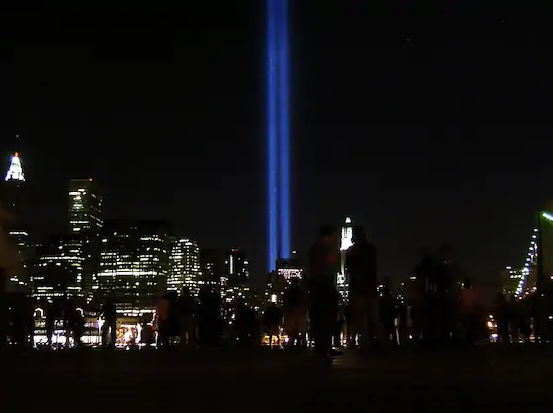
This month, on the 25th anniversary of 9/11, musicians share their memories of that unforgettable day.
September 15th, 2001 was my first sub date on the Off Broadway production of “tick, tick…BOOM!” That was the first night shows in the city resumed after 9/11. The whole city seemed abandoned, and I remember it being a small audience, which included my wife and a close friend. But there was such an overwhelming sense of community and togetherness. It was almost our way of saying “We’ll get through this…we’re going to be all right.”
Dennis J. Arcano
That day, I wrote a song called “September 11 2001” — just my way of dealing with things. Three days later I wrote “Truth is the First Casualty,” for obvious reasons. Both are free online; Google their titles plus “Hitman Blues Band.” I played gigs for a number of survivor families, which ran the gamut from mourning to actually happy (don’t ask).
Russell “Hitman” Alexander
My family and I were checking out of a Jersey shore hotel. We noticed a building fire on the reception desk T.V. During breakfast, we heard the horrible news. The highways were closed.
We stood on the sunny boardwalk, feeling helpless and guilty to be at the beach. Our phone didn’t work to check on a friend who worked near the towers.
I remembered that I had watched the construction of the Twin Towers as a kid.
The next morning I saw my neighbor vacuuming her SUV. She told me how she sat in a traffic jam on the West Side Highway watching the second tower being struck. She worked blocks from there.
She then pointed out all the ash covering her once-white SUV. We both started to cry realizing its contents.
Jon Berger
Days after 9/11, my group Antibalas was playing at a fundraiser on the street in Williamsburg, right by the water. A fire fighter was there alone, dancing and holding his hands in the air in the peace sign, occasionally kissing the cross on his neck. Later that week I asked Will Connell (the legendary copyist and woodwind player) what a musician should do about this world. He said the birds sing whether it’s peaceful or a battlefield.
Stuart Bogie
I was playing the Blue Note in Tokyo and after the second show, someone ran backstage to show us a photo of the first tower that was hit. On our way back to the hotel, the van we were riding in had a TV so we were able to watch the news feed of what was going on. We were devastated to say the least! We were stuck in Japan for five days. I remember that when we did finally leave, the airplane was all but empty. Arriving at JFK, I realized immediately that America was very different from the country I left two weeks before.
Carl Carter
The thing that I remember most clearly about returning to my piano bar gig after 9/11 was wondering what the hell I was going to play. The bar was very busy; people wanted to be surrounded by friends, but everyone was very nervous, emotional, and pretty much still in shock. It seemed highly inappropriate to play light, happy music, but I certainly didn’t want to play anything overly sad or dark. I thought the “peace and love” anthems from the 60’s and 70’s would work best – songs about coming together and caring for one another – and I was right. As it turned out, customers wanted to have their spirits lifted, and playing and singing those songs was therapeutic for me too. I was very moved by the healing power that music had, and felt a new sense of purpose as a musician.
Clare Cooper
My most indelible musical memory of 9/11 involves the late Michael Brecker, the great saxophonist who was due to open a one-week engagement at Iridium on that Tuesday, 9/11. That opening night and the next were canceled, but Mike insisted on fulfilling the rest of the gig, playing Thursday through Sunday, and giving all of the proceeds to the Red Cross.
I was there on one of those nights, along with Mike’s wife Susan, some of his management team, and about a dozen others. It was eerie; before the show, I stood in front of the club, out in the middle of Broadway, which was completely silent except for police motorcades roaring through Times Square every few minutes. The burning smell from downtown was heavy in the air — jet fuel and God knows what else. Mike and his Quartet played an absolutely amazing set. He started by announcing the Red Cross donation, and saying, “The people that did this want us to shut down. But this is New York. We play jazz here. We have to do this, to show them and ourselves that we can go on.” As is well known by those that were knew and still know Mike Brecker, his musicianship was exceeded only by his humanity. I walked away that night knowing that we’d come out of this, thanks to his words and music.
David Demsey
In September 2001, I was living in Brooklyn. I commuted to work in Manhattan each day by walking across the Brooklyn Bridge then catching a subway to Midtown. On my way to work on 9/11, I heard a passerby say that the World Trade Center was on fire. I scrambled up to the bridge and saw flames coming out of one of the towers and thick, black smoke. I could also see what looked like a gaping hole. It was around 9:30 a.m.
My mind couldn’t grasp the fact that steel and glass were on fire. How can a tower burn? I started walking towards the flames. Meanwhile, hundreds of people were streaming at me in the opposite direction. Some were crying.
I made it to the corner of Church and Chambers. There were hundreds of people staring up at the burning towers. I remember being hypnotized by the sight: you couldn’t take your eyes off of it. I clearly remember seeing a small shape fall out of one of the towers. It fell quickly as if it were heavy. Hours later I realized that I had probably seen a person jump to his death.
I soon got an intuition that I had better get out of there. A slow panic was spreading and many people started hurrying north on Church, myself included. I caught the A train at Canal Street and Sixth Avenue. I found out that a short time later, the towers collapsed. I had left the scene at the right time.
Once at my job, I called my parents in Michigan and told them I was all right: they hadn’t heard the news yet. I called my girlfriend (now my wife) and woke her up and told her I was all right: she didn’t know what had happened. Soon after, all the phones went dead.
I worked normally for a few hours, following the news online. Gradually, I learned what happened. Soon, everyone at work was dismissed. I knew that the subways had been shut down. I was a great walker and could easily walk the 1.5 hours home to Brooklyn but I heard all of the bridges were closed. So I walked uptown instead, to my girlfriend’s apartment on the Upper West Side.
We burst into tears when we saw each other. I spent the next two weeks at her apartment, not wanting to go back to Brooklyn. Every day we could smell acrid smoke, the smell of burning plastic and office supplies, even though we were about 100 blocks away from the Twin Towers. We went out to eat the first night and the entire restaurant was subdued. Everyone was watching the news on TV.
Two weeks later I went back to Brooklyn. Soldiers toting machine guns greeted me at the Brooklyn Bridge. My entire apartment was covered in a fine white dust: I had left the windows open, and dust from the towers had come in. The neighborhood was ashy and it stank.
Weeks went by. More soldiers could be seen all over town. Jet fighters flew low passes around Manhattan. People gasped when ordinary planes flew low approaches overheard, thinking it was about to happen again. We all got used to feeling afraid.
There was also a strong need for people to be together. Almost every day, I went to Union Square, where hundreds of people had set up memorials for their loved ones, missing and presumed dead. During that time, people gathered spontaneously, set up flowers and thousands of candles, placed photographs and poems, engaged in political arguments, and played music. A giant statue of George Washington was decorated with pro-peace messages. In fact, there seemed to be more pro-peace messages than pro-war.
I lost two friends in the tragedy: one was killed in the Pentagon plane, and another was killed in the World Trade Center. Even though the total number dead was around 5,000, the real number of people affected — relatives and friends — was more like 500,000 or a million.
Many months later, I visited Ground Zero for the first time. It was just a bunch of blocked-off streets, some fencing and the rumble of construction equipment. There was no place to get a perspective. What I remember most was the smell, like burning plastic. It burned my lungs. It hurt to be there.
Mikael Elsila
I got up early to practice a big percussion setup for an upcoming Scott Johnson premiere with New Millennium Ensemble. When I went upstairs around 10 a.m. to brew some coffee, my housemate, trombonist Randy Hestand, was glued to CNN and told me the World Trade Center had been hit by a plane. Dumbfounded, I looked at the TV and exclaimed, “Holy sh$!, there’s so much smoke you can’t even see the south tower!” Randy, very deadpan said, “That already collapsed about an hour ago, man.” A few minutes later the north tower fell before our eyes. It was truly shocking to imagine how many lives were lost at that moment. Outside the house in Englewood, all the back roads were clogged all day with diverted traffic from the George Washington Bridge, folks just sitting outside their cars listening to the radio in shock. For the next several days, even in Englewood, we could smell the fires. Driving in that Friday morning to accompany dance classes at Marymount College was surreal indeed. The dance students were still in shock as was I of course, and the energy in the class was very low. The teacher leading class just said, “If you’re here today, you’re here to work, people. Let’s go!” I just drummed my heart out that morning.
John Ferrari
On the morning of 9/11, I had just pulled into the parking lot of the school in New Jersey where I was teaching clarinet, when preliminary news of a plane hitting the first tower came over the radio. As the morning progressed and the news got worse, I kept running back to my car radio between students to hear what was happening. We were told not to say anything to the kids to avoid panic. I remember writing the date in one of my student’s lesson books and making a mental note that I would never forget that date again. Family and friends from as far away as Spain kept calling me on my cell. It became impossible for the faculty to maintain a sense of normalcy. I left school around noon hoping to get home before they closed the roads, but by then it was too late. Thus began a 20 hour odyssey (including a stay in a Red Cross shelter somewhere — I still don’t know where) in an attempt to travel the 10 miles from the school to my apartment near the Lincoln Tunnel.
In the dark days following, it was difficult to imagine life returning to normal. In many ways, 9/11 was the beginning of the end of my career as a musician, although I didn’t know it at the time. Work had been slowly diminishing for me as a perennial sub in the years preceding 9/11; once that catastrophe hit, no one subbed out their shows or orchestra gigs for a long time. I had been thinking about a career change anyway, but it was hard to let go of something I had loved so much. It took some time — until 2007 to be exact — but I found my way to a new career that has been extremely gratifying. Would I have made the change if the attacks hadn’t happened? Hard to say, but 25 years later I am at peace with my musical career and the choices I have made.
Karen Fisher
The New York Philharmonic was in Frankfurt Airport returning from a European Tour. I had left my collegues earlier and had landed in England for a vacation. As I boarded the Heathrow bus, the driver was blasting the BBC news on his radio and I was plunged into a nightmare.
At first it didn’t seem real or possible, and then I found myself crying out loud despite disapproving stares from passengers. Suddenly it wasn’t “a small world after all.” It was impossible to get home – or even to call home. I felt isolated and profoundly alone.
I waited five days for a seat on Lufthansa, stuck in a surreal “vacation” I now loathed, listening to sympathetic European news reports tinged with ‘they deserved it’ undertones.
We landed in a completely deserted JFK, the airport closed and empty. I remember wanting to drop to my knees and kiss the ground. In the early dawn of the next morning I was on the ferry from Staten Island heading towards Ground Zero like a homing pigeon. Facing the wind, we moved towards a pile of rubble and an acrid plume of smoke, towards a painful reality and a terrifying new world, but I was home…I was home.
Katherine Greene
Since I live here in Manhattan, I was and still am in a kind of shock after this terrible thing happened. In many ways we live in a totally different world today and I knew right away it would be that way after seeing the images and the shock on the faces of my neighbors as we rode the elevator at Manhattan Plaza, where I live. Pain, horror and shock are the words that come to mind and I still sometimes have nightmares about it, to tell you the truth. The only way I know is to write music from such a situation. I find it personally uplifting. I wrote and recorded my own humble tribute to the victims of 9/11, “Get Back In The Groove.” Wherever we perform this tune around the world, the reaction is unbelievable. Ten days after 9/11 we went to Germany. American flags were flying everywhere. We have a lot of friends over there, folks.
Jon Hammond
I was in a recording studio in London on a lunch break, when the concertmaster of the orchestra rushed into the control booth with the news that “a plane had hit one of the Twin Towers at the WTC.” This was followed moments later by the announcement of a the second tower being hit by another, larger plane, followed by the Pentagon attack report. That’s when I realized that the USA was under attack. We found the only T.V. in the place and watched horrified as the whole drama unfolded. It seemed unreal at the time, and I didn’t sleep well for the remaining three weeks I was in London. When the limo crossed the bridge into Manhattan upon my return is when it really hit me: the New York skyline was changed forever. As we entered the city there was an eerie silence and flags were draped on buildings for as far as the eye could see. This atypical silence lasted for several months, as if the city was in shock.
William H. Hicks
I’ll never forget how from the roof of my building in Brooklyn, I could see twin pillars of smoke and dust where the Twin Towers had stood just a short time before. That was the only day I ever practiced with the T.V. on, glued as I was to news of the tragedy. I wouldn’t have practiced at all that day if not for a looming recital, which became dedicated to the 9/11 victims and their families.
Raphael Klayman
I awoke to the sound of the phone ringing. The voice of my husband on the other end of the line informed me that there had been an accident – a plane had flown into the World Trade Center. I immediately drew back the curtains to see a gaping hole in the side of one of the towers with black smoke pouring out. I flipped on the TV to see what was going on only to find that the announcers didn’t know much more than me.
Unbelievably, as I watched the screen, another plane flew into the second tower. I turned quickly and saw the fireball “live”. Not knowing what to think, I made my way to the Boulevard. Boulevard East is a scenic street that meanders along the top of the Palisades from Weehawken through West New York, my town. I went out to find neighbors and others gathered gaping at the surreal sight. One informed me that a plane had flown into the Pentagon. I immediately dismissed it as a conspiracy rumor.
Returning to my apartment, I once again looked out the window and wondered why there were now clouds of dust around the towers. From my angle the towers had been almost behind one another and I didn’t realize that while I was going up the stairs, one tower had collapsed. Finally, and unbelievably, the second tower sank, almost in slow motion into the consuming dust cloud.
In the days that followed, I could see the smoke coming from the huge emptiness in the skyline. I followed the news as hospitals made preparations for the expected overflow of wounded, only for it to become painfully clear that there were not going to be that many. I was at the waterfront when the Red Cross boat arrived to help with victims that were never going to materialize. When I returned to work the following week, I saw the thousands of posters of missing people plastering the subway walls and it was nearly unbearable.
I put down my horn. I didn’t play. What was the point? Music was so trivial in comparison to the size of the tragedy. I went ahead the following weekend with my planned re-tiling of the kitchen floor and I wondered if I would ever get used to the empty spot where I always saw the towers, even if just from the corner of my eye.
Flash-forward to Sept. 11, 2010…my trio (Zinkali Trio) gave a remembrance concert with a portion of the proceeds going to the Families of September 11th fund. Many people found the concert a comfort, and as the reviewer put it: This unusual ensemble has found absolutely gorgeous music written or arranged for them, and their unique sound, with that sanctuary’s lovely acoustics, made what should have been a difficult day’s night, an evening of consolation. It turns out that music is not trivial after all.
Now, I am surprised when I look out my window and see the new giant tower. I did finally get used to the gap, but it took a long time. What I’ll never forget, however, are those that died and served that day.
Susan LaFever
On 9/11, My wife left our Queens home to work in Manhattan. When Manhattan got put on “lockdown” after the terrorist attacks, I arranged for my wife to go to some fellow musicians’ homes in Manhattan until she could safely arrive home. I also realized it would accelerate the ending of the long run of “Les Miserables” which I was playing for at the time.
Bill Lanham
My new rock cello power trio, Von Cello, was just starting to gig in the months before 9/11. We had gigs booked on Bleeker Street that week. The clubs were empty. A month later I brought the band to Nashville. They didn’t suffer the same trauma down there but they treated us like celebrities because we came from the city of 9/11. After driving that whole night I opened up a rock festival in Harrisburg, PA playing the Star Spangled Banner (in memory of the victims). They were so touched they had us play it again in the evening. (The performance is on YouTube.) On the ride home I could barely keep my eyes open but I felt I did my little part to shed some light during those dark days.
Aaron Minsky (Von Cello)
On the morning of 9/11, I was supposed to fly to San Francisco. I had been invited to take an audition out there for the New Century Chamber Orchestra. I had an eerie feeling, and a voice actually told me in my head that “Sept. 11 is not going to be a good day to fly.” I didn’t heed that voice.
I witnessed the 9/11 attacks from my living room window at Waterside Plaza, on 25th Street. My three- year-old daughter was stacking Lego blocks as the towers fell. When I went out onto the street, legions of ashen-faced workers silently marched up First Avenue. In the next days, I found myself singing with my guitar at Union Square at candlelight vigils, leading people who had convened to give comfort, seek support and share in the words and music of John Lennon, Carole King, George David Weiss, as posters with pictures of those missing surrounded us.
Brian Muni
My memories of 9/11 are as surreal as a painting by Salvador Dali. I was stationed at the West Point Band at the United States Military Academy as a trombonist. We were in the middle of rehearsal when one of the band members came into the rehearsal hall and whispered something in the colonel’s ear. We took a break and went to the lounge area and turned the TV on. As the entire world watched, we were in shock as another plane hit the second tower.
We did not return to rehearsal but waited to hear what our next order of the day would be. Eventually the word came down to us to return home to our quarters and wait for further information. We were told the academy was locking down at 12 noon. No one was coming on or off after that time.
I went home and eventually heard from my future husband, who also worked at West Point. He came over that evening. At about 11 p.m. the phone rang. It was the non-commissioned officer in charge of scheduling a security team that would be used to help guard West Point for the following weeks. I was told to report to the weapons armory at 5:30 a.m. We were met by other members of the Army and we checked out M16 rifles with live ammo. I have to admit, there were some woodwind members of the band who I felt should not have a weapon, but that is another story.
It was a very nervous time for all of us. I personally was assigned to guard part of the Hudson River by the boat marina. At one moment I had to challenge a man who was walking up the railroad tracks. I didn’t know who he was, if he was carrying a weapon, or if he was going to try and blow something up. It turned out he was the harbor master himself. He actually appreciated how I wouldn’t let him proceed any further!
All of our lives changed that day. We played many memorial services for the victims of 9/11. It was an honor, but it never got any easier as time went on. We also played at the Veteran’s Day parade in New York City that year. I’ll never forget the streets lined with family members still holding up pictures of their people with signs asking if we’d seen them anywhere. The looks on their faces and the tears flowing were heart wrenching. Sadly, I’m sure many of them were never found.
I continued to play an occasional Broadway show while still stationed at the West Point Band. I was always looking up at the sky on my way to a show.
I retired from the West Point Band in 2005 and now live upstate. I think our great nation was so innocent before we were attacked at home. I pray it never happens again, but if it does, I’ll gladly report to the Armory again.
Lori Salimando-Porter
I am a vocal coach, educator, composer and pianist (Broadway’s “Blood Brothers” and “Swinging on A Star.”) I was living on the East Side and I had come home from the gym when I saw on TV the first plane hit. I remembered that I was to coach a student who wanted insight on some of her repertoire. She was a registered nurse, talented actress and competent singer, with passion. She came in to the apartment and we watched the TV together as more tragedy struck. Our friendship developed because of this tragedy and we bonded as teacher, student and colleague.
Steven Silverstein
As a musician, I mostly remember the two days after 9/11. I played in a couple of local clubs in New Jersey on those nights, and they were overflowing with people. People needed to be with one another. They needed music. They needed reassurance that life would go on. People were grieving and loving and affirming life. There was anger, there was defiance, but there was no fear. On one of the nights, I played with the Dalton Gang at Trumpets in Montclair (filling in for my pal Conrad Zulaf). The great alto player Mark Friedman played a beautiful version of “New York State of Mind” with the band. Some of the guys in the band were crying while we played. It was incredibly moving. I knew people who died and one who had a miraculous escape. It was all so horrible, but the way the people of the city and suburbs reacted to it all made me very proud to call myself a New Yorker.
Erick Storckman
I had a contract to play at Windows on the World on Sept. 22, for a 40th birthday party, with an excellent pianist known to everyone who will read this, who lives by playing piano and has no other skills and lives meagerly. When 9/11 occurred, I gave him the deposit money as compensation for the missed gig. I explained this to the husband, who was the client. But he didn’t “hear” me, and started asking for the deposit back. We had a phone conversation where he flew off the handle and screamed every insult at me, and accused me of taking advantage of a situation, said his wife was volunteering and helping out so many victims, and here I was showing selfishness. He mailed me a bill for the deposit money. He himself had requested this specific pianist! Yet he didn’t want to understand the situation. He threatened to sue me. I think he was a lawyer, but don’t remember. I was so freaked, like everyone else, by what had happened, and so on the edge of my sanity, that I wrote a check for the amount out of my own bank account, now at my own expense, spat on the envelope and sent it to him. Good riddance! I felt I couldn’t stand one second of contention or I’d just go over the edge. I know that many folks felt that way. It was just another case of exploitation and objectification of musicians. We’re fine when we play, but when we need to eat or survive…hmm, it’s another thing.
Carol Sudhalter
I am not only a jazz pianist and composer but an electrician. At about 7:30 a.m. on 9/11, I was installing a light fixture at a restaurant in downtown Manhattan. When the first plane struck sometime later that morning, I heard a loud bang. This bang was like thunder, and at first I thought an underground subway car derailed causing this noise. I immediately put down my tools and ran to the front door. I saw lots of glass shards flying in the air. I just left my tools and ladder, and ran to my car. I drove fast in an attempt to just get out of the area. I drove onto the Brooklyn Bridge. When I got to Brooklyn, the other plane struck. I realized something big happened as I saw many people in the streets talking on cell phones outside on that sunny day. Plenty of black smoke, and it was a mess! I am blessed I got out of there when I did avoiding, the toxic dust and smoke. God was looking out for me that day. The effect of 9/11 was terrible. My tip glass had very few tips in it when I played solo piano. Gigs just evaporated as people were scared to go to New York. The economic downturn started on 9/11. I am sure many musicians who work for tips felt it. Times are still very bad – and getting worse.
Stuart H. Tresser
In September 2001, I was the pianist on Sunday and Monday evenings at the Cafe Pierre. Kathleen Landis, who normally played Tuesdays through Saturdays, was unable to get into the city on 9/11 and asked me to sub for her. As I went in the 61st street entrance to the hotel, I saw a row of young people slumped on the sidewalk up against the building, crying. Because Cantor-Fitzgerald’s emergency center of operations was upstairs in the ballroom, the Cafe was packed not only with stranded travelers, but also with friends and relatives of the missing, including the brother of one of the pilots. Fred Alger, whose company was also in the Twin Towers came up to the piano with tears in his eyes as I played “We’ll Meet Again” and the “White Cliffs of Dover.” Somehow those World War II songs about love and loss resonated in that roomful of devastated people and seemed to help them through the long, sad night.
Nancy Winston