
Allegro
MEMBER SPOTLIGHT: BRANDEE YOUNGER
Volume 126, No. 4April, 2026
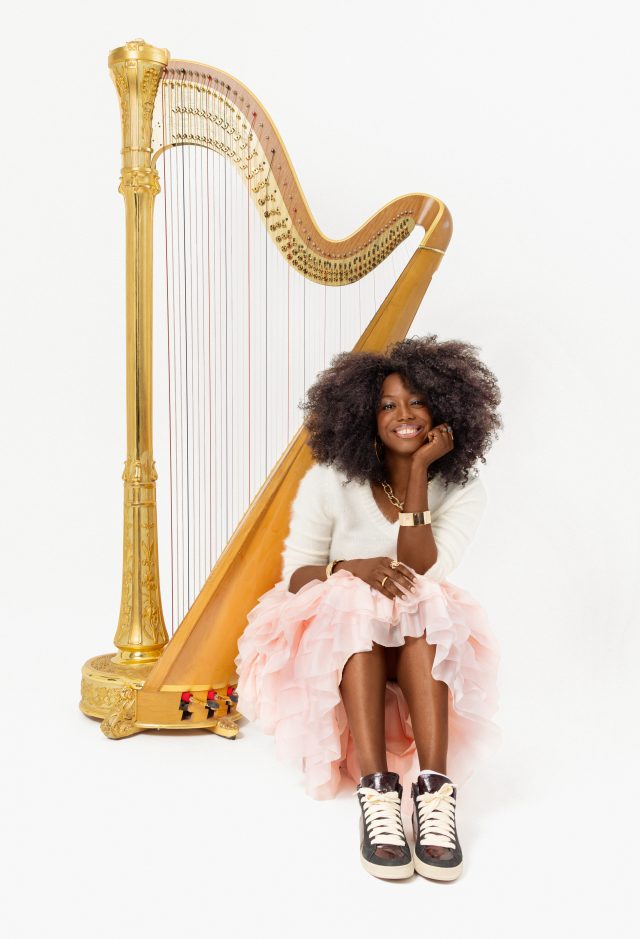
photo by Erin Patrice O’Brien
Brandee Younger, a member of Local 802 since 2017, is revolutionizing the harp’s role in modern music. For nearly two decades, she has worked relentlessly to stretch boundaries and reimagine what is possible for harpists today.
In 2022, she made history as the first Black woman to be nominated for a Grammy for best instrumental composition. She later earned the 2024 NAACP Image Award for outstanding jazz album and was named a 2025 Doris Duke Artist Award recipient.
Ever-expanding as an artist, she has collaborated with cultural icons like Stevie Wonder, Common, Lauryn Hill, John Legend, Pharoah Sanders, Christian McBride, Pete Rock and Meshell Ndegeocello.
Younger’s work has received widespread critical recognition, with her most recent recording “Gadabout Season” appearing on “best album of the year” lists in The New York Times and NPR. Released on Impulse Records, the album marks her most personal and exploratory work to date. Produced by bassist Rashaan Carter and recorded largely in her Harlem apartment, the album features predominantly original compositions and showcases her evolving use of electronic textures and extended harp techniques. With guest appearances by Shabaka, Courtney Bryan, Niia and Josh Johnson, “Gadabout Season” moves beyond interpreting the legacy of harp visionaries like Dorothy Ashby and Alice Coltrane, carrying their language forward through Younger’s own distinctive perspective. The album traces an emotional arc that searches for joy, beauty, and meaning amid life’s complexities while further establishing the harp as a vital voice in contemporary music.
Younger’s music is grounded in purpose and legacy while opening new pathways for the harp to reach audiences far beyond traditional expectations of the instrument. In addition to performing and recording internationally, she serves on the faculty at New York University’s Steinhardt School and The New School College of Performing Arts.
April is Jazz Appreciation Month, and Allegro reached out to Brandee Younger to ask her about her musical journeys.
ALLEGRO: Hello, Brandee! Tell us about your earliest experiences with music.
BRANDEE YOUNGER: My parents are not musicians but they love music and I was exposed to gospel in church (I sang in the choir), plus lots of old school R&B. And as a native New Yorker, I was listening to hip-hop, of course. My very first music teacher was my “Aunt Bert.” She was a close friend of my grandmother and my family and also the organist at my church. She lived up the block, so I took my first lessons with her. Admittedly, I wasn’t the best piano student. In fifth grade, I began playing the flute. I continued through high school, though somewhere along the way my music teacher switched me to trombone. I will say that I had some of the best band teachers a student could have. Ms. Irene Vann taught me flute in elementary school and later came to high school to help the band after school. Mr. Cedric Lemmie continued our private instrument lessons and led the jazz band. Dr. Frank Abel was our marching and concert band director. The three of them worked with us day in and day out, creating what was perhaps one of the most impactful musical periods of my life. Every morning, we had marching band rehearsal outside before school started, which taught us tremendous discipline. We marched in parades in New York City, including the Macy’s Thanksgiving Day Parade, and we competed in marching band competitions around the country. I studied harp outside of school, except for special instances like the school musical or orchestra parts. My primary home at school was in the band.
ALLEGRO: Did you study music in college? Who were your teachers, what ensembles did you play with, and what was your biggest takeaway?
BRANDEE YOUNGER: I studied harp performance and music management in undergrad and harp performance in graduate school. Tons of orchestra, contemporary ensemble and chamber music. Chamber music became my strength and that explains why I love working within small ensembles today. I love the ability to have space for musical expression and small ensemble gave me a way of doing this that orchestral playing did not. I love playing with people…but with just a few! This way we can all have a say and make creative decisions together.
ALLEGRO: What were your earliest professional musical experiences?
BRANDEE YOUNGER: I think it’s no surprise that as a harpist, I played a lot of weddings. Even my high school teachers trusted me to play for their weddings and I took each one very seriously. Also, the local chapters of the sororities and fraternities would hire me to play for their events.
ALLEGRO: April is Jazz Appreciation Month. When did you get into jazz and when did you start improvising on the harp?
BRANDEE YOUNGER: I was lucky enough to play trombone in my high school jazz band. Naturally, I wanted to try playing some of that music on the harp. It wasn’t until my father gave me an Alice Coltrane CD that I heard how the instrument could sound in that context. I loved the sound of the harp within a rhythm section. In college, I used some of my practice time to learn standards and play with other music students in the jazz department. I even registered for independent studies so I could informally take lessons with members of the jazz faculty. Over time, I began improvising on the harp. Two of my biggest mentors after school were tenor saxophonists Antoine Roney and Ravi Coltrane. They helped me develop ways to execute ideas that worked well on my instrument. Ravi Coltrane also reframed the way I thought about recording. I didn’t want to record an album because I wasn’t “ready,” but he said that an album is simply documentation of where you are in that moment. Thinking of it this way really helped me to start to put music out and refine my voice.
ALLEGRO: This may be an impossible question, but what’s it actually like to improvise on the harp? Are there particular strengths — and challenges?
BRANDEE YOUNGER: It’s very easy for the harp to sound “hokey,” and I’m very aware of that. After all, it’s a harp! I love my instrument, but I’m also serious about it being used as an instrument that can hold its own, like a piano or a guitar. That said, I want to play melodic material while still making it sound effortless. The harp can play all 12 notes in the scale, but quick chromatic passages can pose a challenge. I’ve had to find ways to work around this or work within pentatonic modalities to create more fluid lines. It’s a lot to think about. What I love so much about Dorothy Ashby’s playing is that she plays some really hip lines, yet doesn’t shy away from the harp sounding like a harp. We hear lines, glissandos and arpeggios, and it all sounds so effortless and natural.
ALLEGRO: When was the moment you decided to commit to the life of a professional musician? How did you know this was going to be your path?
BRANDEE YOUNGER: I think I knew right after school that I would still be playing. But it wasn’t until I performed at Alice Coltrane’s memorial in 2007 that everything really crystallized for me. In that moment, I understood that my path would be about creating my own sound on the harp, playing within a rhythm section, and composing my own music. I often call it my Oprah “a-ha” moment. That moment also became the driving force behind the ideas that continue to guide my work. I think a lot about the harp and its roots in Africa, and how today the instrument is most widely associated with Western classical music. Bridging that gap has become an important part of my voice as an artist. I’m interested in the space between where things originate and how they live now, and how music can function both as personal expression and as part of a larger cultural continuum.
ALLEGRO: What was one of your recent favorite gigs?
BRANDEE YOUNGER: Well, just this past fall, I played duo with Stevie Wonder at Hollywood Bowl and I am still beside myself!
ALLEGRO: Let’s say you meet a young person who’s obsessed with becoming a professional musician and is willing to do whatever it takes. What’s your best advice for someone like that?
BRANDEE YOUNGER: Do not let obstacles steal your joy! We don’t want the light that is inside of us to dim because life throws curve balls. Do whatever is necessary to keep it burning Also, listen to all kinds of music and not just the style that you’re studying. I’m all for getting rid of the labels. And lastly, of course, practice!
ALLEGRO: Why do you think unions are important or valuable or necessary for musicians?
BRANDEE YOUNGER: Unions are incredibly important for musicians, especially when it comes to protecting fair wages, working conditions and providing access to benefits like healthcare and pensions. When those structures are in place, they can make a real difference in sustaining a long-term career. At the same time, a lot of musicians today are working in more flexible, freelance environments, especially in jazz and other contemporary spaces. I think there’s a real opportunity for unions to continue expanding how they support those musicians and the venues we work in. There’s no question that we need more support as a community, and unions have the potential to play a major role in that. When it works, it’s incredibly valuable.
ALLEGRO: Is there anything else that you’d like to share?
BRANDEE YOUNGER: I think what’s unique about my musical background is that I’ve built a career around playing music that feels true to me. Rather than conforming to what the harp is traditionally known for, I’ve shaped the instrument around my own voice. My work blends jazz, old-school R&B and classical harp traditions into something that feels authentic to who I am. That process has taken time, but it’s been essential. If there’s anything I would pass along, especially to younger musicians, it’s to be authentic. Take the time to figure out who you are and what you want to say, and be true to that.
ALLEGRO: Lastly, why is music important to you?
BRANDEE YOUNGER: Music says what words cannot. It has the ability to make even the toughest person feel something — joy, sadness, pain, relief — It holds the entire emotional spectrum. It affects both the listener and the player in the most genuine way. I’m not sure there’s anything else that can quite do that.