
Allegro
‘The Show Almost Didn’t Go On’
Reflections on our successful Broadway campaign
Volume 125, No. 11December, 2025
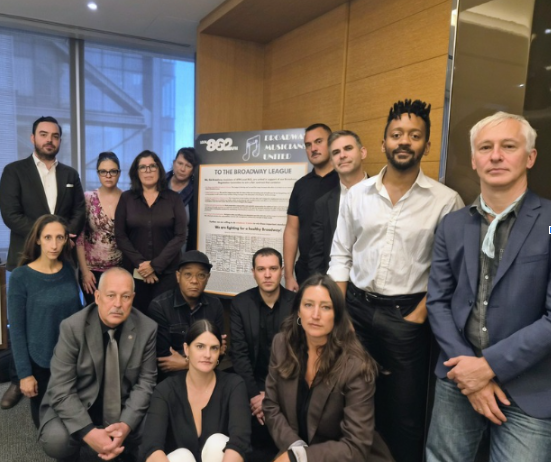
As you may have seen in the news, Broadway workers came as close to a strike as possible without actually calling it at the end of October. Local 802’s contract negotiations with the Broadway League lasted nearly 12 weeks with very little movement until the wee hours of the morning on Oct. 23, with a deal finally being reached at 4:30am with the help of a mediator and an incredibly dedicated team.
So how did we get here?
There is an incredible amount of behind-the-scenes work that happens when any contract is negotiated, and with one of the most complex contracts with multiple employers and a large, diverse bargaining-unit with varied interests and opinions, a lot of care and consideration needs to go into every step of the process. The committee wanted to share some thoughts on how we got to this point and how we can continue to build moving forward.
This contract campaign really began around the ratification of the last agreement, an 18-month-long deal which was ratified nearly six months after the expiration of the prior agreement. This deal only addressed wages and pushed a few pressing issues like Health and Safety into small groups between 802 and League members to be resolved over the course of the contract. It became clear to the committee at that time that this deal was just pushing off some of the larger issues and regressive proposals from the League that were at stake, and that in all likelihood we had a fight ahead of us. Because of the shortened timeline, a new committee was elected just a few months after the ratification, in March of 2025, and started meeting to talk about strategies in April.
Negotiations are so much more than what happens at the bargaining table. Our organizing campaign ultimately became a huge part of the success of this negotiation, and so we wanted to highlight all of the work, collaboration, and careful consideration that went into making that happen. Organizing can take on many shapes and sizes, but at the end of the day it is the most powerful tool, and, in my opinion, the ultimate responsibility that any union has when faced with employers who don’t want to be reasonable.
One major organizing decision that we made early in the process is to try and keep the bargaining unit informed as things moved through the various steps of negotiation. While there are strategic reasons to withhold certain pieces of information, (for example, it’s not to our benefit to have the League hear about our proposals before we put them across the table, so specifics of that nature aren’t made public) we still wanted the whole bargaining unit to feel included in this process. This was a departure from past practices, and it helped tremendously to bring everyone together when things got tough. The Theatre Committee also formed an Organizing subcommittee, which began the business of establishing the lines of communication between the committee and the unit. Since communication goes both ways, a survey to hear from everyone working under the contract was the first step to get people engaged and talking about the contract. The decision was made by the committee to do an abbreviated survey that focused on prioritizing the issues from the much longer and more in-depth survey that had been conducted for the previous contract, while leaving room to bring up any possible new issues for this negotiation cycle.
We were generously lent the services of the AFM International organizing team throughout this process, since Local 802 is currently without an organizing department. First, Gabe Kristal, Director of Organizing for AFM ran organizing trainings for our members in late April. This got people in the room together having conversations not just about organizing, but about contract concerns and potential strategies for warding off the attacks we thought were coming. Over ___ members attended those trainings, which was a great base from which to build the rest of the campaign.
Another behind-the-scenes move that was made after a lot of discussion was the decision to coordinate our bargaining with Actor’s Equity. For the first time ever, we had an opportunity to multiply our leverage by staying in communication with them as our processes progressed. 802 President Bob Suttmann met with AEA’s Executive Director Al Vincent, the committees of both unions had a meetup where they got to communicate about where overlap might exist in our contracts, and Recording Vice President Dan Point had weekly calls with Equity’s staff to make sure we were aligned when moves were made.
Our across the table sessions with the Broadway League started in the beginning of August, and immediately the tone was set. Members of Actor’s Equity’s team, including Executive Director Al Vincent, Jr., sat on our side of the table for opening statements, and we attended their opening day as well, which rattled the League, as I genuinely believe they never expected us to work together in this capacity. Where proposals were concerned, after careful consideration of the past negotiations’ difficulties and the current state of things, the committee decided to come to the table with a narrow, but important, list of proposals on which we thought we could make some real progress. In return, we received a pages-long list of proposals from the Broadway League which threatened every single pillar of our contract, added up to regressive wages, and threatened to eliminate jobs and positions within our contract that have been the standard for decades, all under the guise of the League trying to “modernize” the contract. It’s still unclear what that word really meant in this context. From In-house contractors and subs to copyists and orchestrators, every single person who works under this contract would have been impacted in a negative way by these proposals, and we knew that it was going to be a big fight to keep our hard-earned protections in this contract.
Negotiations went nearly nowhere for over a month, as there was a bit of stalemate around the “economic package,” for which we were waiting for more information about the 802 Health Plan before we could give them concrete numbers for our proposal. We knew that we would need a significant increase, and put forth two innovative proposals that would have reduced the cost burden for new shows or shared the costs of a plan in a different way, but they were immediately rejected by the League. The League also refused to back down from their punitive, regressive proposals, as they cried poverty in a year of record-breaking grosses.
Speaking of, let’s talk about that New York Times article. In late September, just as things were heating up with both 802 and AEA, a conveniently timed piece called “The Broadway Musical is in Trouble” came out, offering the public a broad overview of the League’s across-the-table narrative. In reading the comments, this did not sway the public opinion in the way it was intended. This article, however, was a great rallying cry for both AEA and 802 members to start fighting back on social media. For better or for worse, social media is an information dispersal tool which, when used well, can be a boon to a well run campaign. Between the work of 802 Communications Director Mikael Elsila and the member-driven Instagram page Broadway Musicians, we were able to share facts about our actual costs to producers, refute some of the biased and unspecific information that was given there, and to remind the greater public that there are people behind all of the numbers being thrown around, and live theatre is an art form that deserves the full live experience. We also shared profiles of working Broadway musicians (see here, here and here) as well as a montage made early on in the campaign. 802’s PR team also got to work, with the help of Dan Point, and were able to get quotes in a number of response articles that came out in the weeks to come. This was so successful, in fact, that when asked for comment, the League’s go-to quote eventually became “‘Good-faith negotiations happen at the bargaining table, not in the press.”
Our organizing team decided it was time to ramp things up, as talks seemed to be getting mostly nowhere. The committee had made some small moves to keep things moving, but there were still glaring issues on the table, and the League simply would not understand why there were certain things on the table that we just couldn’t accept, despite many small group discussions and bringing in in-house contractors to explain what the job actually entails. A “Whatever It Takes” Petition was sent out to the entire bargaining unit, and we scheduled pit visits with every single one of the 20 shows that were open or in previews to talk about the issues at hand. These in-person visits were also a great way to have conversations that are harder to accomplish on a Zoom meeting or through email. Ultimately, over a thousand bargaining unit members signed that petition, and we printed it up on a poster board and hand delivered it to the League before walking out of the room following a particularly egregious wage proposal that they passed across the table on October 1st. This may have been the first time the League realized that our organizing efforts were paying off and we could not just be steamrolled.
As the next few days progressed, it became clear that the only way we could make meaningful progress on these negotiations was by ratcheting up the pressure on the League even further. Following just a few days after Actor’s Equity, we decided that we had to do a strike authorization vote. The committee held an extremely well-attended emergency meeting, led by Committee Chair Steve Lyon, where we laid out the facts, allowed members to ask questions, and we talked about leverage and why now was the time to apply pressure, and what else could be done to keep building on the momentum that we were building. That vote was open for four days and ultimately came back with 98 percent of those voting to approve the strike. To say this was a show of strength in our unity is honestly an understatement, and it sent a clear message to the League, and to the public, that we were ready to fight for our contract.
Meanwhile, all of this was getting attention from elected officials, including NY State representatives, and members of Congress, many of whom signed on to letters written by their colleagues urging the League to bargain fairly with 802 and AEA to avoid a strike, since Broadway has such a major impact on the city’s economy (see here and here). We also did a joint leafleting campaign outside of the TKTS Booth in Times Square, disseminating information and talking to audience members about the issues at stake in this negotiation. The League was beginning to feel the pressure from all angles.
And then on Friday October 17th, Equity spent 22 hours bargaining with a mediator, and finally reached a tentative agreement with the League. Our lawyer Evan Hudson-Plush reached out insisting that the committee caucus to discuss next steps–he knew that the next few days were crucial for us having maximum leverage, and we told the League that if we didn’t have something on the table that we could present to our members by the following Wednesday, we would be out on strike come Thursday morning. Eventually, the League agreed to meet with us and a mediator to try to come to some sort of agreement. We did another leafleting session at the stage doors and audience lines as a final show of solidarity, and another escalation of the organizing campaign, on the Tuesday before our Wednesday deadline.
On Wednesday October 22nd, we went to the table once again, this time with the mediator. We spent 45 minutes or so discussing how the day would go, first on the agenda being that both sides would drop all of their proposals outside of wages and health contributions. The mediator then spent over an hour and a half with the employers in their own room discussing things, and then we were summoned to the table so that the League could deliver a speech to start the day. This was the only time that the full groups met for the entirety of the day, and it was a memorable moment. Across the table, the Broadway League agreed to try to reach a deal, but in the same breath threatened that if we chose to strike, (their words, not mine) they would respond by essentially dragging the strike out for weeks, refusing to meet until we agreed to punitive terms that would amount to tearing up our contract, eliminating all of the hard earned protections from decades of collective bargaining. It was an interesting start to the day, really–however, it is to be noted that the fact that the League had resorted to threats told us that they were terrified that we would actually follow through with the strike, and that’s thanks to every member who voted yes to authorize.
After this unfortunate start to things, the day inched by, with offers being passed back and forth through the mediator representing only the tiniest of movements on each side. There was one exchange in which, after an hour, we got an offer that moved a quarter of a percent and five dollars in health benefits. Suddenly halfway through the day, the length of the term (from 12 month to 14 month periods) was changed in the employer’s offer, and then we had another essentially new proposal to consider. The goal on their side seemed to be to give us a deal that, numbers wise, was anything less than what Equity received, which was something we knew on our side we could not accept. There were a number of sidebars in which a few members of the League and the chairs, union officers and staff, and our lawyer met to discuss where things were going in a more informal “off the record” way, which kept things moving forward. Ultimately, the mediator recommended, at three in the morning, that we present what was pretty much our bottom line in one of these sidebars, to remind them of the human element here that we are not just numbers on a piece of paper. With a tiny modification, the League finally accepted this deal, which became what the bargaining unit received to ratify, and at 4:30 in the morning, we shook hands across the table and made our separate ways home.
I want to acknowledge that on paper, the ultimate result of where we got with this negotiation, with just wage and health increases, doesn’t look like a lot. However, saying that would fail to recognize all of the negative space in this deal–essentially, all of the incredibly regressive proposals from the employers against which we were able to hold firm and force off the table, thanks to the solidarity of the workers involved. For a long time in our bargaining patterns, we have been required by the employers to give up work rules in order to get even smaller increases than what we saw here, and I’m proud to say because of everyone involved we were able to break that pattern.
So where do we go from here? The unequivocal key to the success of this contract campaign was the level of engagement and buy-in we had from every member of this bargaining unit. In an ideal world, we would not just let all of this energy lay dormant for the next two and a half years until we need it again. How can we continue to serve our members even during the years when we are not under direct attack? How can members stay involved so that when the need arises again, we are even more prepared than this time?
Please forgive me my soapbox moment here, but this is the crucial time for members to lean in in multiple ways. In order to show our value to our employers, we need our audiences to be unable to imagine a world in which they would buy tickets to see a show that doesn’t include us. In order to get our highest priorities as a bargaining unit straight, we need folks to show up to Theatre Committee meetings, join the Organizing subcommittee, to show up to membership meetings, and to understand and participate in the process, not just of Broadway, but with Local 802 as a whole. By being transparent about this negotiation, we built so much more community within our bargaining unit, and we want to keep that going. We want to hear from you–what do you think we should all be doing together to amplify our message and address concerns going forward? What can we implement in the next two and a half years so that the tone of these negotiations is different from the start? A strike is always a last resort, but the fact that we had to threaten one and that we were prepared to do it this time went a long way. The world in which we may have to do this again is not unlikely, but maybe there can be a better way moving forward. We need to remember always that it’s not “We’re just lucky to be here,” but rather “They are lucky to have us,” and we want that message to carry further than just within our own membership. Let’s work together to bring that message into the public eye. If we were to use this time to do that, the conversation will have to be different next time.
In solidarity, your committee:
Steven Lyon, chair
Sarah Haines, vice chair
Deborah Assael
Matt Brown
Rachel Drehmann
Andrew Griffin
Martha Hyde
Rob Jost
Maxim Moston
Greg Riley
Corey Schutzer
Allison Seidner