
Allegro
WHAT’S IT REALLY LIKE TO PLAY ON A CRUISE SHIP?
MEMBER TO MEMBER
Volume 126, No. 10November, 2026
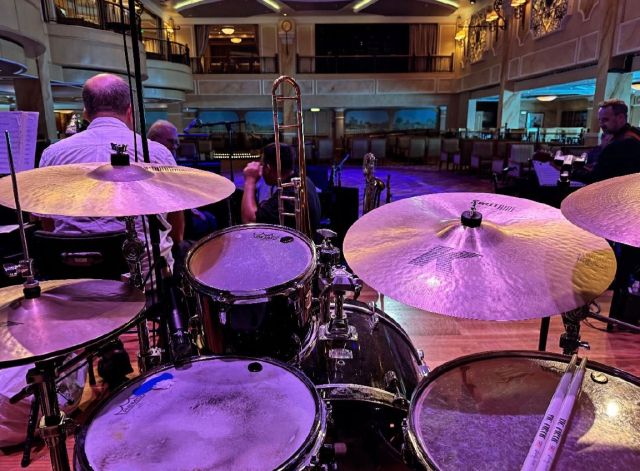
I’ve never had to choose between New York and the sea. For the past decade I’ve done both, currently as resident drummer aboard Cunard’s Queen fleet while staying a working New York theatre drummer on paper and in practice.
The surprising thing about ten years of doing this work at sea isn’t the travel. It’s how much the job depends on versatility and continuity at once.
In a single stretch I move from a full pit score for a Tony winning musical to a jazz combo to a rock set, then repeat that rotation days later in a different room with a different band. The itinerary changes. The audience changes every night. Personnel rotate in and out on staggered contracts. The reading still has to be clean and the time still has to be steady, regardless of which chart lands in front of me.
My work has spanned theatre productions, orchestral programs, big band and musical direction. The job is never just knowing the drum part. It’s sight reading a score cold, adapting to a different genre almost overnight, and understanding how the playing supports the cast, the ensemble, and the production, then delivering that, reliably, across an extended contract.
The Arc
I earned my Bachelor of Music and Master of Music degrees from Berklee College of Music, including graduate study in contemporary performance at Berklee’s campus in Valencia, Spain. I built my technique studying privately with Mike Mangini, Kenwood Dennard and Yoron Israel, three teachers who pushed me in different directions: precision and control, feel and groove, and the language of jazz.
I spent eight years with Royal Caribbean International as a theatre and orchestra drummer, then as musical director, leading rehearsals and preparing orchestras for major productions. My book from those years includes “We Will Rock You,” “Mamma Mia,” “Grease,” “Hairspray,” “Cats,” “Dreamgirls” and “The Wizard of Oz,” alongside big band, jazz, pop and rock.
I’m now theatre drummer for Cunard’s Queen fleet, principal drummer for our ship’s featured musical “Come From Away” and currently resident drummer aboard Queen Victoria. A typical week moves between that Tony winning musical, Cunard’s own production shows, guest headliners and big band nights in the Queen’s Room, several genres deep in a matter of days.
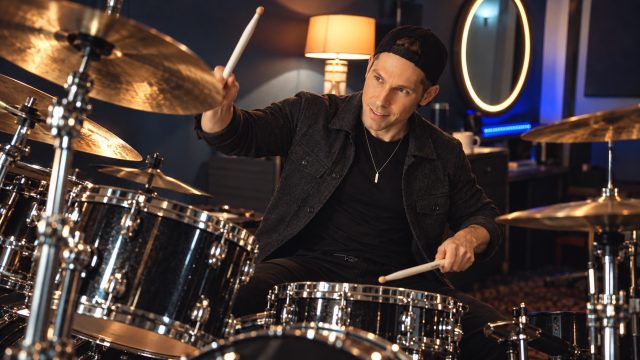 Local 802 Connection
I consider myself a New York City theatre drummer first, whatever coastline my current contract happens to be sailing along. Local 802 is where that identity lives on paper as well as in practice: I’m a Broadway sub drummer, and I stay available for sub calls, pit work, studio sessions and tours whenever my schedule allows.
The reading and range a Cunard contract demands, a full pit score one set, a jazz combo the next, a rock set after that, are close cousins of what a sub call in this city demands. Staying connected to Local 802 while my chair keeps me at sea for most of the year isn’t a stretch. It’s the same standard, wherever the room is.
As a resident theatre drummer aboard Cunard’s Queen Victoria, my principal workplace is the main theatre, located at the forward end of the ship. The evening’s program may feature a guest entertainer, requiring precise sight-reading; a production show with the resident cast of singers and dancers; or our featured musical, “Come From Away.” Rehearsals generally begin between 4 and 5 p.m., followed by two evening performances. For “Come From Away,” a longer production performed without an intermission, rehearsals begin around noon, with performances scheduled later in the afternoon and evening to allow sufficient time to reset between shows.
That schedule usually leaves mornings and much of the day available for personal practice, exercise, or time ashore. On port days, provided we have no scheduled duties, we can leave the ship and explore, returning in time for our commitments and the ship’s departure. The balance between concentrated evening work and relatively independent daytime hours is one of the distinctive features of the job.
Accommodations and connectivity
Theatre musicians aboard Queen Victoria share two-person interior cabins with bunk beds on Deck A, approximately at sea level. The cabins have no windows and include bureau and wardrobe storage, a refrigerator, a television, and both standard electrical outlets and USB connections. In practice, the cabin serves primarily as a place to sleep, with much of the day spent rehearsing, performing, practicing, or exploring ashore. Sharing the space requires consideration for a colleague’s schedule and routines, particularly over a four-month contract.
The ship’s Starlink connection has made staying connected considerably easier. During my most recent contract, an unlimited crew internet plan cost approximately $9 per week, and the connection was strong enough for remote lessons, family calls, and streaming. That access makes a meaningful difference when living and working away from home for several months.
Dress and presentation
Concert black is the standard performance attire. On formal evenings, we generally wear full tuxedos, although the musical director may adjust those requirements to suit the demands of a particular production. As a drummer, I have been permitted to perform without the jacket when greater freedom of movement is needed.
Dining
Musicians are classified as staff and generally dine in the staff mess. There is also a crew mess, while officers and certain management personnel, including the musical director, dine in the officers’ mess. The dining areas offer different selections reflecting the varied backgrounds of the ship’s personnel. The staff mess typically includes European and American dishes, along with a separate selection of healthier options.
In my experience, Cunard has been attentive to dietary restrictions, and the catering team can help when the available selection does not meet someone’s needs. A posted menu also provides options that can be prepared on request. For example, I can order grilled chicken breasts when I need a straightforward meal outside the regular selection. Having meals provided removes a substantial practical expense from daily life.
Safety responsibilities
Every crew member, regardless of rank or department, has an assigned emergency responsibility. My assigned safety duties include crowd control, with musicians stationed in major public spaces such as the dining rooms, Queens Room ballroom, Grand Lobby, and main theatre. Our responsibilities involve helping gather and direct guests according to the ship’s emergency procedures.
We participate in weekly safety drills, generally held between 9:30 and 11 a.m. These responsibilities are part of our working week alongside rehearsals and performances.
Guest interaction
We are expected to be approachable, courteous, and professional without intruding on a guest’s experience. Cunard places particular emphasis on polished presentation and respectful interaction. When guests approach us, we are encouraged to engage warmly and thoughtfully while maintaining appropriate professional boundaries. Even away from the stage, we remain representatives of the company.
How musicians can pursue this work
Musicians entering cruise ship work often begin through specialist recruitment agencies. These agencies review résumés and performance portfolios, conduct remote auditions that may include sight-reading, and recommend successful applicants to cruise lines for available positions. Agency arrangements may involve a commission calculated as a percentage of the musician’s earnings, so applicants should review those terms carefully.
Cunard offers a direct recruitment route. I work directly for the company without an agency relationship or commission. For musicians considering this work, understanding the recruitment arrangement is an important part of evaluating an opportunity alongside the repertoire, contract length, and onboard responsibilities.
Applicants should prepare a professional résumé and performance portfolio, supported by recordings that demonstrate their suitability for the particular ensemble position. Strong sight-reading is central to the work, particularly when accompanying guest entertainers. For a drummer, dependable time, stylistic range, dynamic control, and the ability to respond quickly to musical direction are equally important. The audition process should be approached as preparation for the actual chair: the goal is to demonstrate that you can read accurately, listen closely, and support a performance under professional conditions.
The strongest aspects of the work
Cunard offers the opportunity to travel internationally while maintaining a sustained professional performance schedule. Accommodation and meals are provided, and the working day often leaves substantial time for personal practice. That combination can create an unusually productive environment for a musician.
Some of the most focused periods of my musical life have happened aboard a ship. I have been able to begin the day with several hours of practice, take that concentration into rehearsal, and perform twice that evening. Daily performance gives the practice an immediate purpose. Over an extended contract, that rhythm can produce significant growth in technique, musical judgment, stamina, and confidence.
The challenges and contract structure
The principal challenge is maintaining a connection to life and professional relationships ashore. Even with reliable internet, several months away can create distance from the musical community at home. Staying in touch with colleagues and remaining engaged with their work requires deliberate effort.
There is also the psychological challenge of repetition. After several weeks, the schedule becomes familiar, and maintaining freshness requires discipline. For a theatre musician, that is valuable experience: repeated performances demand concentration and care long after the material has become comfortable. A healthy balance of practice, exercise, rest, and time ashore helps sustain that standard.
My Cunard role follows a four-month-on, two-month-off rotation. Resident musicians return to the same vessel, while relief musicians cover their leave. A rotational musician divides a four-month contract between two ships, spending approximately two months aboard each. As a resident musician on Queen Victoria, I spend my full four-month working period on that vessel. That continuity allows me to develop a close working relationship with the company and its repertoire, while the scheduled leave provides time to reconnect with home and pursue work ashore.
Performing in a moving theatre
One of the stranger challenges of performing at sea is that the theatre moves with you. Depending on where we are sailing and the sea conditions, the ship can rock considerably more than usual during a performance. As a drummer, you are already coordinating all four limbs, following the music, and supporting the ensemble. Occasionally, you also have to concentrate on staying upright.
An unexpected movement can catch you off balance and send you pitching forward over the drums. You have to steady yourself quickly enough to land the next downbeat without interrupting the performance. There is something quietly comical about that extra layer of coordination: the audience is watching the show, while you are recovering your balance behind the kit and making sure the music carries on. It gives the expression “keeping steady time” a rather literal meaning.
From Dubrovnik to the drum chair
One of the more surreal aspects of the job is how much a single day can contain. On a port day in Dubrovnik, Croatia, I can spend the morning ashore exploring the city, then return to Queen Victoria for rehearsal and two performances of a production show with our resident cast of singers and dancers. Within a few hours, I have gone from being a visitor in Croatia to being back behind the drums, concentrating on the score and supporting the cast.
The transition becomes surprisingly ordinary when you do this regularly, but occasionally it strikes me just how unusual that working day is. The morning belongs to a place I may have traveled thousands of miles to see; the evening belongs to a production and an ensemble I know intimately. By the time the second show finishes, the ship may already be heading toward our next destination.
The Takeaway
I wrote this piece so a fellow Local 802 member could come away with a clearer picture of the musicians doing this work. “Cruise ship drummer” names a location, not an identity. I’m a New York theatre drummer whose current chair happens to be aboard Cunard’s Queen Victoria, and the standard doesn’t change with the address.
For me, the value of these ten years has been sustained technical practice across genres: sight reading a new score, moving between big band and jazz book without missing a beat, leading rehearsals, and being accountable to an ensemble over time. Wherever the theatre happens to be, the aim is the same: become the musician people can trust with the music, in any style put in front of me.
Gregory Szaro has been a member of Local 802 since 2013. Personal essays published in Allegro (including MEMBER TO MEMBER) do not necessarily represent the opinions of the union or its members, officers or staff. To give feedback on this article or submit something to Allegro for consideration, send to allegro@local802afm.org.