
Allegro
MEMBER SPOTLIGHT: CYNTHIA MENG
Volume 126, No. 3March, 2026
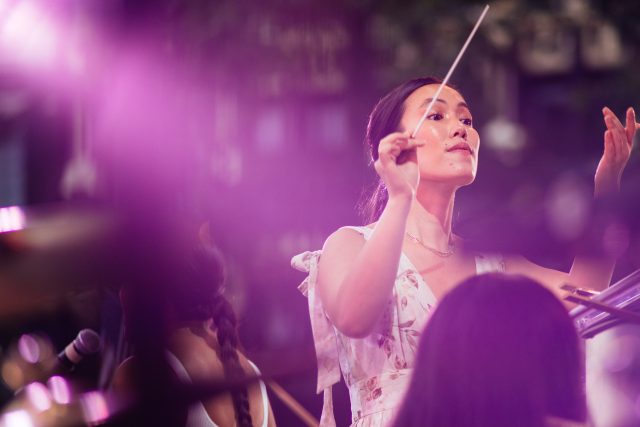
Cynthia Meng, a member of Local 802 since 2019, is a New York-based music director and pianist. She is the assistant conductor and keyboard player for Lincoln Center’s celebrated revival of “Ragtime.” In 2025, she served as the Associate Music Director for the Broadway musical “Dead Outlaw,” nominated for seven Tony Awards. She is a member of the Broadway music team for the the eight-time Tony- and Grammy-winning production of Anaïs Mitchell’s “Hadestown.” In addition, she has played keyboard for the Radio City Christmas Spectacular and has played around the world as a sidewoman and pianist (Hollywood Bowl, Lexington Symphony, Dallas Symphony at the Bravo Vail Festival, Denver Symphony).
In the film world, Cynthia served as the Associate Vocal Supervisor for “Spirited,” an Apple TV+ movie starring Will Ferrell, Ryan Reynolds and Octavia Spencer, as well as the third season of Hulu’s “Only Murders In The Building” starring Selena Gomez, Steve Martin and Martin Short. Other select favorites from the theatre realm include Gloria Estefan’s “Basura” (upcoming world premiere in May 2026), “Lempicka,” “The Outsiders,” “The Jonathan Larson Project,” “Back to the Future,” the 2022 Broadway revival of “Company,” the 2022 Broadway revival of “Funny Girl” starring Lea Michele, “Suffs” at the Public Theatre, “The Last Five Years” from Out of the Box Theatrics, and “In the Green” at Lincoln Center Theatre. In a past life, she was a software engineer and a Harvard grad.
For this month’s member spotlight, Local 802’s Allegro magazine caught up with Cynthia to find out more about her inspirational musical life.
ALLEGRO: Can you tell us how your journey in music began?
CYNTHIA MENG: I was a classically-trained pianist as a kid and did the competition circuit, which helped build up chops and a base level of classical theory. I also really enjoyed singing and was very involved in school choir, which is eventually how I discovered musical theatre. In college, I started music directing shows and really took to it, and (after a small detour) pursued it professionally in NYC after I graduated.
ALLEGRO: Did you grow up in a musical family? Tell us about how your parents did (or did not) expose you to music?
CYNTHIA MENG: Neither of my parents are musical, but my Chinese name actually contains a character for a Chinese flute (sheng). I think my parents, who immigrated from China, wanted me to be a “well-rounded” American kid and so they put me in piano lessons from a young age, which was really my first exposure to music in childhood!
ALLEGRO: Talk about your first musical experiences in school, including any conductors, bandleaders or private teachers who were most important to you.
CYNTHIA MENG: I went to public school in the Bay Area, and my high school had a really excellent choir program (we also have a couple of Broadway actors from my school!) My choir teacher and our accompanist, Stacey Kikkawa and Paul Caccamo, were so incredibly important to my musical life during those formative years: they constantly encouraged me to conduct and perform and showed me strong musicianship for many years. Stacey even strongly encouraged me to pursue collaborative piano in school (something that probably would have benefited me a lot, given where I’ve ended up…). I also did a lot of community theatre, and our director, Leslie Noel, exposed me to the world of musical theatre. Doing piano competitions was incredibly isolating and honestly, terrible for my mental health, and I specifically remember loving choir and musical theatre because I got to make music together with other people.
ALLEGRO: What were your earliest professional musical experiences?
CYNTHIA MENG: I was part of a theatre troupe in college (the Hasty Pudding Theatricals) that gave me my first sense of rehearsing, putting up, and doing a run of a professional show. I was the student conductor of the show for two years, and the company was able to hire a professional director, music director, and tech lead to put up a student-written musical in a month, and then it ran for a month and even went on a weeklong mini-tour over our spring break. That was actually my first exposure to what I do most often now, which is work on new musicals.
ALLEGRO: Did you study music in college? If so, tell us about what this was like. Who were your teachers, what ensembles did you play with, and what was your biggest takeaway?
CYNTHIA MENG: In college, I actually majored in computer science (though I did get a minor in music). Ironically, the computer science major required very few credits to actually qualify for graduating, so it allowed me to take all sorts of different classes during my collegiate years, including a jazz harmony course with Dr. Daniel Henderson, someone who really believed in me and encouraged me to develop my musical ear and instincts.
ALLEGRO: When was the moment you decided to commit to the life of a professional musician? How did you know this was going to be your path?
CYNTHIA MENG: There wasn’t really a “eureka moment.” It was really a slow burn for me (or maybe a slow boil). I was so scared to actually make a leap into being a freelance musician — I feel like I opted for the safe choice so often in life, and this was no different. I was leading a double life for quite a few years, always on the precipice of quitting my day job but never committing. After a few years of “double duty,” I realized I couldn’t be really excellent at either thing I was doing (engineering and music) while “half-assing” both, and decided I needed to at least try to wholeheartedly pursue music: I would have regretted it for the rest of my life if I didn’t attempt it.
ALLEGRO: How did your musical career proceed after college? What was your first big break?
CYNTHIA MENG: I worked for a couple years at Pandora as a software engineer right out of school. I actually really loved that job and still keep in touch with many of my former coworkers, many of whom have come to see me conduct in shows over the years. Working in tech was very flexible, and it allowed me to gig at night and on weekends, and then sometimes do workshops of new shows as well. But it wasn’t until right after I officially quit my tech job that I ended up landing the music assistant job at “Hadestown” for its Broadway run in 2019, which I would consider my “big break.” It felt like kismet!
ALLEGRO: What has been your favorite gig over the years?
CYNTHIA MENG: I have so many favorite gigs and they usually have to do with the people I am working with. Generally, I love working during the holiday season: playing keys on the Christmas Spectacular (where I met one of my closest friends today) and conducting White Christmas at Paper Mill Playhouse (where I got to work with a number of great friends) are two memorable gigs that come to mind.
ALLEGRO: When you think of who has taught you the most on a gig, who comes to mind?
CYNTHIA MENG: I am extremely grateful to every music director who took a chance on me and “opened the door,” so to speak: I am extremely grateful to every music director who took a chance on me and “opened the door,” so to speak: Remy Kurs, Liam Robinson, the late Howie Joines, Joel Fram, Andrea Grody, Ian Eisendrath, Ted Arthur, Alex Lacamoire, and most recently, James Moore. I feel like I’ve learned so much about leadership and musicianship from every music director I’ve worked for, and how much an MD can set the tone for an entire room of musicians and actors. Also, a few months ago, I gave birth to my first child, and I am eternally grateful for the community of musician moms who have offered me advice and showed me the possibilities of musicianship and motherhood: Meg Zervoulis, Charity Wicks, Madeline Benson (to name just a few.)
ALLEGRO: What was one of the funniest things that happened to you on a gig?
CYNTHIA MENG: I once played keyboard 2 on a children’s production of “Hands on a Hardbody.” During a song, I had to trigger a “car honk” sound (in rhythm), and something went wonky with the MainStage file. The laptop had also been formerly used for a production of “Rock of Ages,” and when I hit the keys to play the car honk, it instead continuously triggered a sample of “gunter, glieben, glauten, globen”…the nonsense intro to the Def Leppard song. We were all dying laughing in the pit. It definitely gave those kids some culture that day.
ALLEGRO: Why did you first join Local 802?
CYNTHIA MENG: I joined when I started playing rehearsal piano for “Hadestown” — so, out of necessity!
ALLEGRO: Why do you think unions are important or valuable or necessary for musicians?
CYNTHIA MENG: In a world where our skill as musicians is increasingly devalued, we need to stand together to advocate for what we deserve in wages, benefits, and work conditions. Artists work under constant fear that if we ask for “too much,” we’ll be passed over in favor of someone who’s willing to undercut their own value. I appreciate that a union helps us standardize the value of the work we do (and it is valuable).
ALLEGRO: Let’s say you meet a young person who’s obsessed with becoming a professional musician and is willing to do whatever it takes. What is your best advice for this young person?
CYNTHIA MENG: Listen to and consume lots of different types of media: music, film, television, dance, visual art… it’s not only good for you as an artist, but it also helps you meet so many different people. Having peers and colleagues who are at your same “level” is just as important as meeting people who are further along in their careers. Those peers will help you get jobs and hopefully you can do the same for them.
ALLEGRO: Why is music important to you? (We know this is a “big question,” but it usually gives the best answers!)
CYNTHIA MENG: Music connects me with the people around me (whether they are professionals or not). I love that a piece of music can inspire conversation on a deeply technical and emotional level, and that there are so many myriad ways to appreciate it. A good melody can transcend language barriers and cultural differences — as a child of immigrants, this is especially salient to me.
ALLEGRO: March is Women’s History Month. The fact that you are serving as the first female conductor of “Ragtime” on Broadway has garnered a lot of recent interest and support. How do you feel about this and what does it mean to you?
CYNTHIA MENG: I’m reminded that visibility is an integral part of equity. One of the most influential conductors in my life was my public school choir teacher, an Asian-American woman (the aforementioned Stacey Kikkawa). Back then, she was just my choir teacher who happened to be an Asian woman, and there were no deep conversations about it. When I started conducting and MDing myself, I had very few hangups specifically about being a woman or being Asian, probably because I had someone early in my life who showed me that it was very possible to do it. I can’t discount how important that ended up being for me — even though it took a few years to make the leap, I found the confidence to do it. There are also a few female music directors who paved the way before I entered the industry — I’m grateful for their visibility, which inspires me still. And I hope I can continue the chain by showing up, taking up space, and doing my job.
ALLEGRO: Can you tell us specifically about how you became a musical director?
CYNTHIA MENG: I spent a few years working as a music assistant — most notably at “Hadestown” on Broadway, and a few Off Broadway and tour productions — and that connected me to a lot of music directors. From there, it was a sort of zigzagging in different roles on a music team across a lot of different shows — some subbing, some rehearsal piano playing, a lot of music directing workshops and readings… I think for me it was always about doing all kinds of different things within this field. It helped me meet a lot of people and learn from them.
ALLEGRO: Is there anything else you’d like to say about your musical career?
CYNTHIA MENG: In some ways, I entered into my career slightly later in life than many of my peers — I think I had a latent desire to do something artistic for a career early on in life but always felt scared or waffled on the decision up until my mid-twenties. There are times still when I still feel really insecure about that, but at the end of the day, I’m happy to say that I truly chose this path for myself, that I meditated on the decision very conscientiously and opted in.