Allegro
A tribute to Gene Bertoncini
Volume 126, No. 9October, 2026
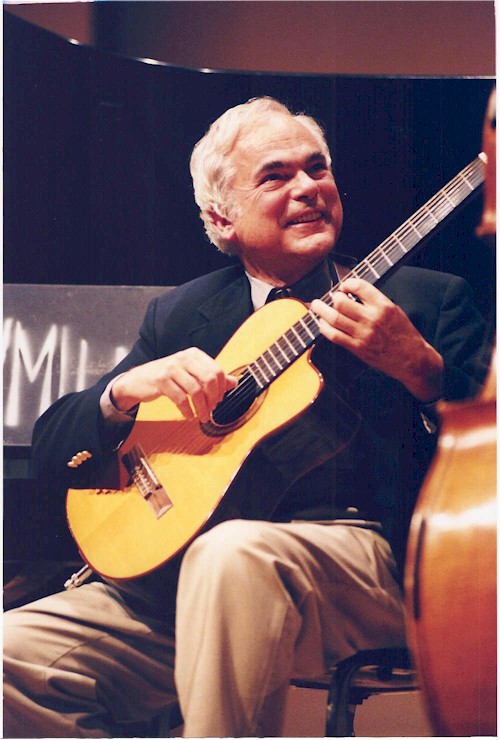
Gene Bertoncini (1937-2026)
This tribute to Gene Bertoncini was originally drafted by Local 802 member Josh Marcum and later edited and amplified into a New York Times piece by Will Friedwald. It appears here in Allegro with the permission of both writers.
Gene Joseph Bertoncini, the world-renowned guitarist, composer, arranger, bandleader, accompanist and educator, died of natural causes on Saturday evening, August 29, 2026, at his residence in the Actor’s Fund Home in Englewood, New Jersey. He was 89.
Gene was born in the Bronx on April 6, 1937, the second and final child of Mario and Anita Bertoncini, who had immigrated from Italy 20 and 26 years earlier. Their first son, Renate — known to everyone as “Renny” — had been born two years ealier, in 1934.
“When I was little, [my father] bought a house that was a wreck, and within a year, he made it into a palace.” Gene recalled in the famous 1986 New Yorker profile by Whitney Balliett. “Ten years later, he bought another wreck, and this time, my brother and I helped rebuild it. What a lot of love there was between us.”
Mario Bertoncini had been a restaurateur, who later owned and operated an Italian restaurant called Joe’s on Third Avenue between 60th and 61st Streets in Manhattan. He also was an amateur musician, and taught his sons to play the music of the old country, Renny on accordion and Gene on guitar. As boys, they were also attracted to American popular music that they heard on the radio; first the songs of the singing cowboys like Roy Rogers and Gene Autry, and eventually the singers and big bands of the 1940s. As boys, they were already working as a duo—the first of many important duos of Gene’s career—in private houses, restaurants, and clubs, as well as playing for dancing classes, in their neighborhood. Gene always said, “[they] could never play enough music for his father.”
Around the time Gene was 12, he and Renny were regulars on an early NBC program titled “The Horn & Hardart Children’s Hour.” For the rest of his life, he vividly remembered going to the NBC studios where he first met one of the great guitar virtuosos of American music, the iconic archtop virtuoso Johnny Smith. Smith became his first guitar mentor, and he would later also study with Chuck Wayne, who in turn encouraged Gene to study classical technique after a life-changing encounter with the music of British-born guitar and lute virtuoso Julian Bream.
In the early 1950s, Gene attended the Power Memorial Academy, an all-boys Catholic High School then located at 161 West 61st Street in Manhattan, not far from their father’s restaurant. He was by then also studying the pre-eminent jazz guitarists of the day, especially Oscar Moore and Charlie Christian.
When he was just 16, Gene had the gumption to join Local 802. (Older brother Renny joined the union that same year.) Gene kept up his union membership even when, a year later in 1954, he enrolled at Notre Dame in Indiana. Partially because there was no such thing as jazz education that early, he majored in architecture, on the advice of a counselor at Power Memorial. Although he would only briefly work in that field after graduation, it was clear that his training in that area was a primary influence on his music. For five years at Notre Dame, in addition to studying, he played in various student ensembles, including a formal concert orchestra and a marching band, doubling on clarinet as well as guitar.
In the final part of his five years at Notre Dame, Gene and his colleagues helped create the first collegiate jazz festival in the U.S. He also led a big band that played for dances as well as a modern jazz quintet that would accompany the legendary jazz singer Carmen McRae in Chicago immediately after his graduation.
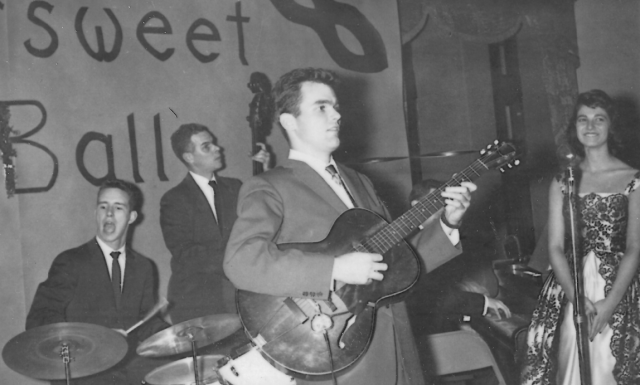
The Gene Bertoncini Quartet, circa 1957: Gene Bertoncini (guitar), Rosie Ferraro (vocals), Wally Jones (piano), Tim McGee (bass) and Paul Willihnganz (drums). Photo courtesy Paul Willihnganz.
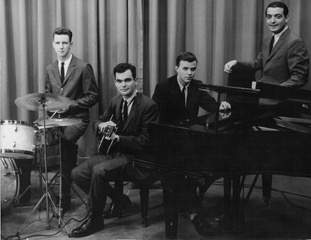
The Gene Bertoncini Quartet, circa 1959: Gene Bertoncini (guitar), Wally Jones (piano), Vince Mauro (vocals) and Paul Willihnganz (drums). The photo was taken at WNDU-TV in South Bend prior to a television show taping, around the time of the first collegiate jazz festival (as documented in the book “Big Noise from Notre Dame”). Photo courtesy Paul Willihnganz.
When he returned to New York in the late summer of 1959, Gene took a day job, an entry-level position in the architectural firm of David Henken, a prominent disciple of the visionary Frank Llody Wright. Among other things, Henken designed and built the celebrated Rudy Van Gelder studio in Englewood Cliffs, where Gene would play thousands of sessions in the 1960s, ‘70s and ‘80s. For a few years he tried to do both architecture and music: in this period, he was playing for such prominent big bandleaders as Richard Maltby and Les Elgart. He also worked as a staff musician on ABC television, playing on screen in support of the entertainer and producer Merv Griffin in the orchestra of the popular quiz show “Play Your Hunch.”
In the middle of one show with Maltby, he had an epiphany; he made a mistake and played a wrong note. Sixty-five years later he declined to specify exactly what happened but it was shocking to his system at the time. “We were playing a chart and there was a line written for the guitar, and I messed it up,” he says. “Probably nobody noticed but me, but I couldn’t live with that. I attributed it to the fact that I hadn’t been practicing enough.”
It was at this point that he made the life-altering decision to put aside his architectural degree and budding career in honor to concentrate on music. He later described this moment to Italian singer Mafalda Minnozzi, who recalled how he broke this news to his parents: “You want to know the most beautiful moment he ever shared with me? When he decided to become a musician for real. He had studied architecture—a ‘secure’ career. His parents had sacrificed everything to put him through school, the way Italian parents do. And he was terrified of letting them down. Early on, his father went to hear him play at a club in the Bronx. Gene was nervous as hell. After the set, Mario walked up to him, looked him straight in the eye, and said: ‘Figliolo, qualunque cosa tu voglia fare, io ti sosterrò al 100 percento!’ He said it to him in Italian. (‘Son, whatever you want to do, I’ll support you 100%.’) You see, that word, figliolo… that’s the key to everything. Gene spent his whole life trying to honor that blessing, trying to make that Italian father proud, the father who had the courage to dream for him.”
One of Gene’s first gigs with a big name, a national bandleader, was playing Birdland with the legendary drummer Buddy Rich; this occurred thanks to his boyhood friend, the vibraphonist Mike Mainieri, who would later go on to found the famous jazz group Steps Ahead. Gene’s tenure with Buddy only lasted a few weeks, but he remembered it vividly. “Buddy really liked the way I played rhythm with him. He just liked that he didn’t have to tell me anything. I was able to just lock into the beat with him, which was amazing, because he was such a dominant force. We just locked in together.”
Gene’s major memory of his brief tenure with Buddy Rich involved the drummer’s infamous temper and the rather vituperative insults he would instantaneously hurl at anyone who displeased him. Said Gene, “There was this kid who was making noise in the front row, and Buddy couldn’t stand it, so after a few minutes, Buddy says to him, ‘Where are you from, kid?’ He says, ‘I’m from Pittsburgh.’ Then Buddy says, ‘There’s a bus leaving for Pittsburgh in 10 minutes. Be under it!’”
In 1962 and ‘63, Gene began working at another iconic venue, the New York Playboy Club, in a trio fronted by the young pianist Monty Alexander, who had recently arrived from Miami and before that, Kingston, Jamaica. They were part of a legendary trio, with the Chicago-born bassist Bob Cranshaw, which played together extensively at the Playboy and elsewhere for a few years before Monty relocated again, this time to the West Coast. But they remained friends for life. Monty described Gene as a good influence on him. He said Gene was the rare musician, “who didn’t do drugs, didn’t drink to excess. He was almost a kind of—some would say—a goodie two-shoes. And it remained.”
Somehow during this busy period, Gene also served in the Marines, starting in the fall of 1960 and then continuing in the reserves for five more years.
By the time Monty Alexander left New York, Gene was working regularly in the recording studios: “I started practicing classical guitar just about the time when the bossa nova hit. Joao [Gilberto] was borrowing my guitar, I was playing the classical repertoire, and all these things kind of came together.” In 1962, the new music from Brazil started to become popular in North America and all over the world; Gene, who had a unique combination of classical technique, and a classical, nylon-string guitar, and a solid foundation in jazz rhythms, was one of the few New Yorkers who could convincingly play the bossa nova.” The first album that we know of by him is Ahmad Jamal’s “Macunudo” from 1962. “I was doing studio work at the time, and I got a call to play on a big album by Ahmad Jamal; they wanted somebody to play a bossa nova kind of thing.”
By 1963 he was playing all over New York and recording frequently, including on two well-remembered small group albums by Clark Terry, soon to be his colleague in The Tonight Show Orchestra. In later years, Gene remembered how he initially subbed in the band as a temporary replacement for a guitarist who, like him, was Italian-American, but much older. He recalled that the band’s drummer, Bobby Rosengarden, didn’t care for this older drummer, “because he wasn’t swinging. But anyway, I got called to go in and play guitar. And as soon as I started playing with Bobby, he yelled out to the leader, Skitch Henderson, ‘What’s right is right!’ So that got me the gig on ‘The Tonight Show.'” Gene would share the guitar chair with Bucky Pizzarelli, first under Skitch Henderson and then Doc Severinson, until Gene left the band to focus on a career dedicated to small groups and live performances. Eventually, the whole program relocated to Burbank in the early 1970s.
In the mid to late 1960s and many years to come, Gene was one of the busiest guitarists in New York, playing sessions at Van Gelder’s or one of the TV networks every day; in the evenings he would play clubs, like The Guitar on 10th Avenue and West 44th Street, operated by Kenny Burrell. It was there in 1967 that he first performed in a duo with bass legend Ron Carter — just off the road with the landmark Miles Davis Quintet. Ron and Gene would only play together sporadically in front of live audiences, but they would make dozens if not hundreds of studio sessions together, including at least 30 albums; among them five with bands fronted by jazz flute superstar Hubert Laws, and a favorite session for Nancy Wilson’s album, “But Beautiful,” featuring the two rhythm players along with Hank Jones on piano and Grady Tate on drums.
In these years Gene seemed to be working everywhere with everyone: Benny Goodman, Tony Bennett, and Lena Horne all wanted him in their bands, and he actually toured internationally—although briefly—with Benny and Lena. He made about three albums with Tony, as well as appearing several times with him on television, including The Ed Sullivan Show in 1968. He played on harmonica giant Toots Thieleman’s American album “Toots” (1968), several sessions with Herbie Hancock (including one with Sonny Stitt), and on Wayne Shorter’s breakthrough “Odyssey of Iska” (1970). His playing on the latter was so well-received that Wayne asked him to join him in the new ensemble he was forming with keyboardist Joe Zawinal, which became Weather Report, but Gene declined because work in New York was so plentiful that he didn’t want to spend a prolonged time on the road.
Around 1970, Gene met bassist Michael Moore (Dave Brubeck, Bill Evans, Benny Goodman, Marian McPartland, Jim Hall, etc.) and within a few years, the two became known around the New York area as The Duo. This would be one of his most important musical associations and friendships, and as such was lauded by prominent critics like Gene Lees and Whitney Balliett. The latter profiled both Gene and Mike in The New Yorker, and he credited Gene and Mike with popularizing the idea of duet playing among jazz musicians far and wide, on a diverse variety of different instruments. The two were regulars at Zinno(‘s) on West 13th St, and recorded several trail-blazing albums for double bass and guitar, weaving seamlessly between the works of Bach, Rachmaninoff, Chopin, Jobim, Puccini, Gershwin/the great American Songbook, and even Lennon-McCartney. One such album added west coast pianist Roger Kellaway.
When Mike left the United States in 1989, Bertoncini turned his focus towards a lifelong quest to write and record solo arrangements for his nylon string guitar, which he often — after Berlioz — referred to as his own complete orchestra.
As an in-demand studio guitarist, Bertoncini worked with Burt Bacharach, and on the scores of film, commercials, and television shows. He can be heard on the hit recording “Raindrops Keep Falling on My Head.”
Some of his proudest moments outside the field of jazz include performances with Pavorotti at Madison Square Garden and performances at the Metropolitan Opera in 1967 under Zubin Mehta.
Gene was an important teacher and mentor, being associated with Eastman School of Music for over 50 years, William Patterson University, and N.E.C., some of his students include Peter Bernstein, Roni Ben-Hur, Paul Meyers, Paul Ricci, and many others. Gene spent 18 years playing weekly, mostly Sunday and Monday evenings, at La Madeleine on West 43rd St, and 10th Ave. through the 1990’s and early 2000’s. He later performed weekly with bassist Josh Marcum at Ryan’s Daughter, in the small Upper East Side Irish Pub’s second floor event space.
A superb accompanist, he worked with many of the genre’s greatest singers including Chet Baker, Astrud Gilberto, Sylvia Syms, Margaret Whiting, Steve Lawrence and Eydie Gorme, as well as Lena Horne and Tony Bennett. Bertoncini was long Bennett’s guitarist of choice and appeared on many of his recordings. Here is Tony introducing Gene to television audiences on an NBC special in 1966. Here they are in 1968 performing together on the Ed Sullivan Show. Gene was a regular staple at jazz clubs in Manhattan, but one of his favorite haunts was Spike Wilner’s club Mezzrow on West 10th St. where he performed with some of his closest friends and longtime associates, including vocalist Melissa Stylaniou, guitarist Roni Ben-Hur, trumpeter Clay Jenkins, and bassist Josh Marcum.
Others whom Gene Bertoncini worked and recorded with in his career include Esther Phillips, Morgana King, Michel Legrand, Mark Murphy, Stanley Turrentine, Susannah McCorkle, Rufus Reid, Bill Charlap and Alan Bergman.
For nearly 60 years, Gene lived in a modest apartment at 211 East 60th Street, around the corner from his father’s restaurant (Joe’s) where he took the entire Tonight Show Band to dine. Finally, during the pandemic, in his mid 80s, he moved to the Actor’s Fund Home in Englewood. In his late 80s, Gene Bertoncini was still actively playing all over the city: Birdland, St. Peter’s, and especially Mezzrow on Sheridan Square in the West Village, where he was acclaimed as a local hero and a living legend.
It was in a particularly triumphant weekend in December of 2025 when Gene and Ron Carter played four sold out duet shows at Mezzrow. The two were almost a permanent guitar-and-bass combination on too many albums to count in the 1970s, many of them for producer Creed Taylor’s innovative CTI label, as well as on Nancy Wilson’s classic 1969 session, “But Beautiful,” with Hank Jones and Grady Tate, and also about three albums released under Ron’s name. Although he played New York several times, even after his 89th birthday in April 2026, this run with his old friend, who was also 88 at the time, was probably his major club date.
Gene Bertoncini had several meaningful longtime relationships, although he never married. He is survived by several family members including his niece and nephew, his brother Renny’s children: Nina Collins and Paul Bertoncini. (Renny died in 2023.)
The memories of two of his prominent students, Paul Meyers and Pedro Rodriguez are particularly relevant here. Paul has pointed out, “Gene lived alone. He never got married and never had a family. The music was his passion.” But when we say Gene never had children, we only mean it in the most literal sense, because thousands of guitarists, those who studied with him, or those who never even met him but memorized his recordings, have learned from him.” Pedro reports. “I asked him once, ‘Do you realize how many children you have fathered?’ For a bachelor, that’s pretty good.”