
Allegro
MEMBER SPOTLIGHT: JAY JULIO
Volume 126, No. 7July, 2026
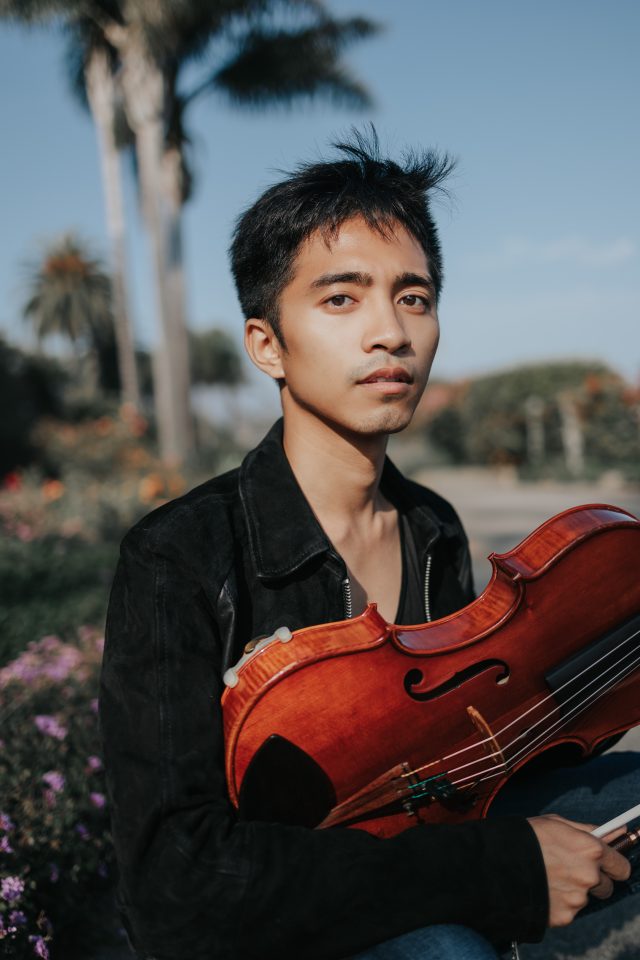
This month we’re thrilled to feature an interview with Local 802 member Jay Julio, the first-ever Local 802 member to win the AFM Charles McDaniel Youth Award given for “accomplishments as a young, upcoming musician in their local and throughout their community.” This prestigious prize is one of the AFM’s diversity awards and is only bestowed once every three years at each AFM convention.
Jay (who uses they/them pronouns) is a first-generation Filipino-American multi-instrumentalist, composer, arranger and writer who splits time between NYC and Philadelphia when not on tour. They serve as assistant principal violist of the Opera Philadelphia Orchestra as well as on the orchestra committee. Jay has also performed with the American Composers Orchestra; Chamber Orchestra of Philadelphia; the Memphis, Charleston and Dallas Symphonies; the Broadway productions of “Sunset Boulevard,” “Ragtime” and “Queen of Versailles”; and for over a year as viola/violin 3 with the touring company of “Hamilton.” Solo appearances include concertos with the Ocala Symphony, the Marquette Symphony and the Brooklyn Youth Chorus, as well as recitals at the Dame Myra Hess Concert Series, the Free Library of Philadelphia and the University of the Philippines’ Abelardo Hall. Jay’s commercial experience includes live shows and recordings with Burna Boy, Major Lazer, Audra McDonald, Mac Ayres and others. They have recorded for Parma, Nonesuch and Broadway Records, including releases nominated for 2025 and 2026 Grammy Awards, and has been heard on radio and TV across the U.S., Australia, and Europe, from appearances on nationally-syndicated “Performance Today” with pianist Josh Tatsuo Cullen to interviews on major media affiliates regarding Asian-American issues. Jay is a 2025 recipient of an Interdisciplinary New York State Council for the Arts grant and a 2025 YoungArts Alumni Microgrant to support the development of their original musical/literary/visual work “america is in the heart,” and served as a Tell Your Story fellow at the 2026 Spoleto Music Festival. Jay’s festival appearances include the Lucerne Festival Academy, the Music Academy of the West, Orpheus@Mannes, the New York String Orchestra Seminar and the Cabrillo, Aspen, Pacific, Thy, Spoleto and Lake Tahoe music festivals. They have also spent summers at the Yellow Barn Young Artists Program and the National Symphony Orchestra’s Summer Music Institute as a Young Artist of Color. Jay has served as a teaching fellow at Juilliard’s Music Advancement Program and as substitute viola & chamber music faculty at the Manhattan School of Music Precollege Division.
ALLEGRO: Can you tell us how your journey in music began?
JAY JULIO: I was born and raised in Uniondale, New York, about half an hour east of Queens, and it’s where I first picked up a violin in public school, realized I was very bad at it, and hopped on YouTube (back before it was all ads) to watch tutorials on everything from Suzuki Book 1 pieces to vibrato and false harmonics. I discovered just how deep the world of string playing could be, and also how behind I was on the “professional music” track — I was teaching myself how to shift for the first time from online references in 7th grade while watching videos of 7-year-olds play the Mendelssohn concerto. But I kept going, to my mother’s chagrin, and eventually I met a member of the then-Long Island Philharmonic (now Orchestra Long Island) in a side-by-side outreach program at Uniondale High School. She taught at the Mannes Preparatory Division, where I would audition — on viola, at her suggestion — and study on scholarship, starting my first private lessons on a new instrument. I was incredibly grateful for the opportunity, having never studied an instrument — or solfège, or ear training — before, but I also continued to see how behind I was. I auditioned for and attended Interlochen Arts Academy, an arts boarding school in northern Michigan, to be able to study music seven days a week. I was there for two years, then started my bachelor’s at the Manhattan School of Music at 16, followed by a master’s at Juilliard, all with teachers and colleagues who deeply inspired and nurtured me.
ALLEGRO: Did you grow up in a musical family?
JAY JULIO: My parents were blue-collar workers — a mechanic and a nurse’s assistant/school paraprofessional/private care worker — who had both grown up in large farming families in the Filipino countryside and immigrated to the U.S. in their late 20’s to be able to send American dollars back to family members who deeply needed them. But music was always part of my childhood; my all-but-in-name godmother would always tell me that any time I cried as a child, putting on a record would immediately quiet me, and there was often music at home both from parents and from the many relatives that were also in New York — disco, alternative rock, rap, R&B, Original Filipino Music (OFM), and Contemporary Christian Music (CCM). Indeed, church offered a variety of traditions, from Pentecostal and charismatic to hymns in Tagalog. And, like most Filipino-Americans, karaoke was a large part of family life.
ALLEGRO: Talk about your first musical experiences in school, including any conductors, bandleaders or private teachers who were most important to you.
JAY JULIO: Though I was a bit of a late starter on the violin and eventually the viola, I am grateful to have been spotted early and nourished by my public school orchestra teachers Susan Weber and Beatrice Flipse, both of whom were passionate about working in a majority-minority district and with students who often could not afford full-freight private lessons, but who truly blossomed in their ensembles.
ALLEGRO: What were your earliest professional musical experiences?
JAY JULIO: Even pre-lessons, my orchestra teachers were deeply involved in making sure I had experience in the industry I so wanted to be a part of. While in 8th grade, I played side-by-side with them in our elementary and middle school orchestra pits, learning books like “West Side Story” and “Annie” and, just as importantly, sight-reading and etiquette skills in safe environments. I would be referred in those years to a youth theater further out on Long Island — I can’t remember much about the gig other than there were multiple rehearsals and I and a friend carpooled to and from, it was maybe $40, and it was my literal very first paid gig. My mom and I opened up a bank account in my name just to deposit that check! A few later, I honed my street performance skills in D.C. while a student at the National Symphony Orchestra Summer Music Institute, learning how to busk before Trader Joe’s shopping trips and bringing that to NYC when I started at MSM.
ALLEGRO: How did your musical career proceed after college? What was your first big break?
JAY JULIO: I graduated right into the pandemic, and not only did it demolish our industry at the time, but it was personally deeply affecting. Most of my family was on the front lines, taking care of people at their worst, and while I was grateful none of my immediate family were lost, Filipinos and Filipino-Americans represented almost a third of all nurse deaths caused by Covid. I spent a year in New York, teaching online and attending Zoom activities run by the diversity fellowship I had auditioned into, the Los Angeles Orchestra Fellowship. Then I spent a year in L.A., graduated from the program and auditioning all the while, winning my first job with the Palm Beach Opera but wanting to return to the coast I knew best. I moved back to NYC in fall of 2022 and won the second chair spot at the Opera Philadelphia Orchestra about a month in, cementing my drive to live here!
ALLEGRO: When you think of who has taught you the most on a gig, who comes to mind?
JAY JULIO: So many people have taught me things on and off the job! First of all, my Musicians United for Social Equity (MUSE) mentor Todd Low prepared me beyond belief to play shows and understand the industry. Sasha Ono is someone whose combination of work ethic, organizational capabilities, and playing versatility floors me continually. Tia Allen’s advice on viola and career has been invaluable. And I’m so deeply inspired by school friends who I continue to work alongside both in musicianship and organizing — Samuel Zagnit, Matthew Jaimes, Sarah Ma and more.
ALLEGRO: What’s one of the funniest things that happened to you on a gig?
JAY JULIO: Not quite a gig, but my freshman recital… we were doing this arrangement of Richard Strauss’ fabulous art song “Morgen” for voice, viola, and harp to end the show. It begins with just the instruments, about a minute of playing before the vocalist comes in. The vocalist had it totally memorized, off-book…until we’re on stage, get to their entrance…and nothing. There’s no good chord in the intro to start from (and mind you, we were a bunch of teenagers then), so the harpist and I just loop back and play the entire intro again. I don’t know how we did shows before masks to cover our faces — I could barely hold it together and I knew if I looked at anyone on stage or in the audience after that, I wouldn’t be able to get through it!
ALLEGRO: You recently won the prestigious AFM Charles McDaniel Youth Award given for “accomplishments as a young, upcoming musician in their local and throughout their community.” This international recognition is one of the AFM’s diversity awards and is only bestowed once every three years at each AFM convention. You are the first-ever Local 802 member to win this award. Can you tell us about your own recent music-related projects in diversity, advocacy, community or social justice?
JAY JULIO: I hope to represent some of the many facets of American musicianship in my choices of what to play, where to play, and how to play it. Some may remember “Sound Off: Music for Bail,” addressing issues of policing and supporting abolitionist pathways to true public safety and racial/gender justice through concerts that platformed speakers and directed audiences to support the Justice Committee, Red Canary Song, VOCAL-NY, and other organizations that directly make our communities safer. A ongoing project with Japanese-American pianist Josh Tatsuo Cullen, who I met on tour at “Hamilton,” is our “Made in America” viola/piano series that we took through Chicago and all across Michigan this past March. We highlighted composers either from the U.S. or who had made it part of their life — including such surprises as Astor Piazzolla, who spent much of his childhood in Greenwich Village, and Nicanor Abelardo, whose native Philippines switched from Spanish to American colonial rule when he was 5 until his death, and who would come to study in Chicago for a single year before lack of funds sent him back. We also premiered works by American-born composers Courtney Bryan and James Lee III, and it was foundational to the planning of that program that we make clear both the beauty of art in and around the United States, as well as the violence experienced by many who are “outsiders” in it. Lastly, it must be said that our musical scene today in New York would not exist without the Black diaspora, from jazz to post-minimalism, and I want to encourage us to keep educating ourselves beyond what we learned in 2020.
ALLEGRO: Why did you first join Local 802?
JAY JULIO: I joined 802 for my first NYC union show in 2022 with the American Composers Orchestra — a groundbreaking concert called “The Gathering: A Collective Ring Shout” at the Apollo Theater in collaboration with the Harlem Chamber Players and Gateways Festival and crucially co-contracted by Jonathan Haas and Lady Jess. This was a first for that orchestra, and it was an honor to come and play for the very first time with a diverse ensemble in contemporary music that honored many aspects of Black American musical traditions in a space so dear to Harlemites and New Yorkers.
ALLEGRO: Why do you think unions are important or valuable or necessary for musicians?
JAY JULIO: A single musician is easily replaced when they ask for fair wages — a few thousand is harder to ignore. In the words of Frederick Douglass, “If there is no struggle, there is no progress. Power concedes nothing without a demand.” Not to be bleak, but our union labor protections are there because working without them kills — whether from shoddy construction falling on someone or from the slow death of poverty wages without insurance in an abusive workplace. We are at a point where even social media virality does not guarantee consistent work, and where billionaires control more of the world’s wealth than any other time in history. And yet we are also in a time of record union support in this country. Now, more than ever, musicians are in a position to benefit from unionization.
ALLEGRO: Let’s say you meet a young person who’s obsessed with becoming a professional musician and is willing to do whatever it takes. What’s your best advice?
JAY JULIO: Everything about this “industry” and, indeed, this art form (because we’re all workers but also creators!) requires true community. You want to be referred to gigs? You have to be known to people and as someone they want to play with. You want people at your gigs? You need to know people who care enough about you and your musicianship to come (and also who aren’t playing a show then themselves…so make sure you have some non-musician friends!) You had a bad employer trying to run off without paying you? You need people to report it to who are in positions to share the news and to do something about it. Please consider local politics to be part of your community as well — your labor protections beyond the contract, any funding for in-school teaching artistry or library concerts, and your quality of life outside of the gig is largely determined by local policy. And in short: be kind and also just, be discerning and also willing to give people chances, and remember that this job is not one that just anyone can — or gets to — do.
You can find Jay Julio on Instagram at @jay.julio and also at jayjulio.com.