
Allegro
A tribute to James (Jim) Wilson
Volume 125, No. 11December, 2025
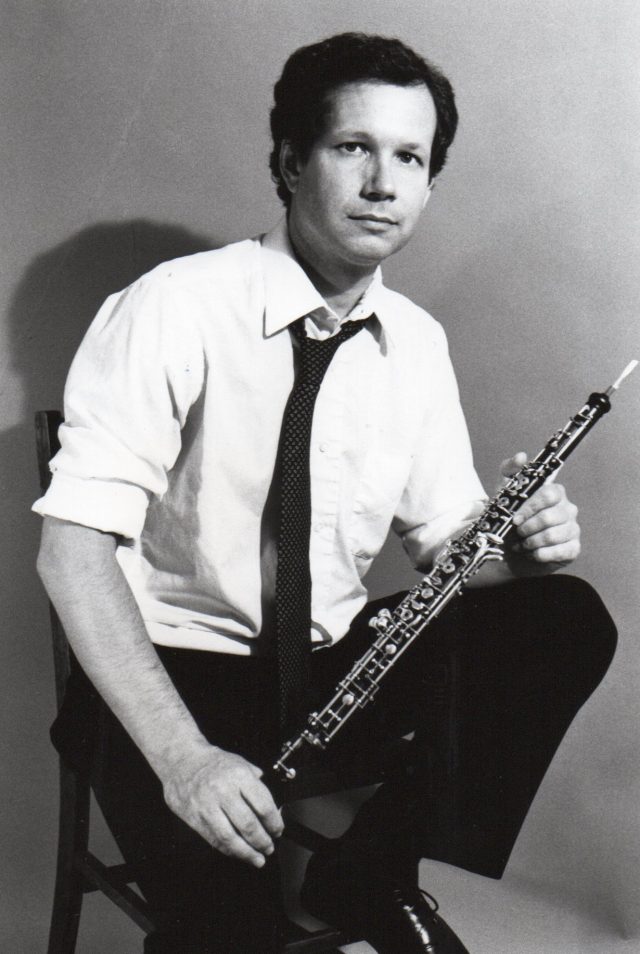
James (Jim) K. Wilson, an oboist and a member of Local 802 since 1971, died on March 25, 2025. He was 79.
Born in Bedford, Ohio on May 8, 1945, Jim grew up just outside Cleveland in Chagrin Falls and Cleveland Heights. His family was full of musicians, both professional and amateur. His mother was a talented pianist; his aunt was a violinist and music teacher; and his grandfather graduated from Oberlin, studied piano and organ in Berlin prior to World War I, and became a professor of music at Drake University in Iowa.
Jim came to the oboe by chance. He signed up for band class in seventh grade not because he envisioned himself as a classical musician, but because it was a convenient elective. In the late 1950s, rock and roll was becoming the dominant sound on the radio, and all summer before school started, Jim fantasized about playing the drums, which he thought would make him look cool and appeal to girls. But on the first day of class, the band instructor directed the students to choose their instruments in alphabetical order, by last name. By the time Jim came to the front of the room, after languishing at the end of the line with the other “W’s,” only the oboe and the bassoon remained. Deciding quickly that he didn’t want to lug around a bassoon case, he resigned himself, with much disappointment, to the oboe. But when he opened the case and saw the polished wood and the silver keys, he had what he later described as a “classic ‘yes’ response.”
It wasn’t long before his oboe became the focus of Jim’s life. At Cleveland Heights High School, Jim met a group of like-minded student musicians, with whom he bonded over a shared love of and deep desire to explore classical music. They learned and taught each other about music by playing music together, listening to music, and discussing it in intense conversations that could last for hours. Every Saturday, Jim and one of his best friends, a horn player whom he had met at Interlochen, would take the bus into downtown Cleveland to visit the public library where they would check out a recording and a score of a selected symphony. They would spend the week listening to and studying that recording and score and then return to the library the next Saturday to check in those materials and check out the recording and score of another symphony. Jim and two other friends, fellow oboists in the school orchestra, formed their own organization called SPAH: The Society for the Preservation of the American Hautbois, and had business cards made up. “Hautbois” is an archaic term for oboe, and Jim still had SPAH cards in his possession at the time of his death.
Many of these classmates would become Jim’s lifelong friends. Decades later, he would pick up the phone and call one of them if he stumbled upon a notable recording of a piece of music he loved, had a new revelation about an oboe solo he had learned in his youth, was trying to remember what work a particular melody running through his head came from, or had made some other musical discovery.
For Jim, growing up in the Cleveland area meant growing up as a young oboist in the orbit of the Cleveland Orchestra, then under the musical direction of the legendary George Szell. Szell and the Cleveland Orchestra exerted a profound gravitational influence upon his musical standards, taste, and sensibility throughout his career as a performer and teacher. Jim held Marc Lifschey, then the orchestra’s principal oboist, in particular reverence. As a boy, Jim was awed by Lifschey in live performance. Years later, he would describe the notes that Lifschey played as sparkling like jewels in the air above the audience in Severance Hall. Lifschey was an early teacher, but Jim’s most important and influential teacher was Alfred Genovese, the principal oboist of the Metropolitan Opera Orchestra. Other teachers included Sally Bloom and Joe Robinson.
Jim attended the Cleveland Institute of Music for a year before moving to New York, where he studied at Juilliard and the Manhattan School of Music. He remained a New Yorker for the rest of his life, mastering the subway system, shopping at the farmers markets, tuning in to WNYC, and spending his downtime at The Film Forum or MOMA.
For close to 50 years, Jim freelanced throughout the New York area. He was the principal oboist of the Bronx Symphony Orchestra for more than a decade and, over the course of 20 years, performed in numerous school assembly programs throughout New York City under the auspices of Teaching Artists for Young Artists, Inc., and the Whirlwind Quintet. Jim also played in or freelanced for the Hunter Symphony Orchestra, Brooklyn Philharmonia CETA Orchestra, New York Lyric Opera, Philharmonia Virtuosi of New York, Julius Grossman Orchestra, Caecilian Chamber Ensemble, Long Island Chamber Ensemble, Westfield Symphony Orchestra, Hudson Valley Philharmonic, Westchester Symphony, New York City Opera, New Haven Symphony, Bridgeport Symphony, Connecticut Opera Company, Metropolitan Opera Company, New York Grand Opera Company, Greenwich Wind Trio, Classic Trio, and Metropolitan Soloists, among others.
He also performed in the NPR broadcast of “The Odyssey,” with music by Eric Saltzman, and played on David Amram’s album “No More Walls” and on an album of highlights from Ned Rorem’s “Miss Julie,” performed by the New York Lyric Opera.
As an oboist, Jim was a perfectionist, well regarded for his tone and attention to phrasing and his reed-making. More than that, his colleagues remember and miss him for his unique sense of humor and his generous spirit. Jim wanted the best for his friends and colleagues; he helped his fellow freelancers get work and supported them personally, as well as professionally. He was also a supportive, patient, and encouraging presence in the lives of his many oboe students. He cared about his students not just as developing musicians but as people. He kept tabs on his younger students, and kept in touch with their families, long after they had graduated from high school, and he remained interested in their welfare and their activities, whether or not they continued to pursue music.
Among the papers that Jim saved over the years are copies of personal notes and letters of recommendation he wrote to and for some of his most treasured students. A number of his students became his personal friends, and many of them made him very proud. It wasn’t unusual, even well after he retired, for Jim to receive a call from a colleague or former student seeking assistance or advice about reeds, embouchure, how to play a particular piece, or how to handle personnel problems in an ensemble. Jim was always happy to receive these calls and always happy to help.
Jim retired from performing in 2015 and taught his last oboe lesson in early 2020. Over the final two and a half years of his life, he suffered a series of small strokes. The last of these, in April 2024, left him with mild expressive aphasia and reliant upon walking sticks and a transport chair. Through it all, Jim never stopped listening to, thinking about, or loving music. Even in the last few days of his life, when he was too weak to do much of anything else, he was still listening and responding to music.
Jim passed away at Calvary Hospital in the Bronx, due to complications from recurrent infection. His partner, Bonnie Walker, was at his side.
In addition to his partner, Jim is survived by his sister Joanie Wilson; his sister Kim Hayes and her husband Ed Hayes; and his nephews, Matt Hayes and Colin Hayes. Donations may be made in Jim’s name to the International Aphasia Movement, an organization that helps people who suffer aphasia due to strokes or other neurological problems, at iamaphasia.org , or to the Local 802 Emergency Relief Fund at https://erf.local802afm.org/donate.
In July 2025, Jim’s family and a number of his high school friends gathered to celebrate his life at First Church in Oberlin, and a portion of his ashes was interred in his family’s plot in Wakeman, Ohio. A memorial service for Jim will be held in New York City in the future. Those who want information about the New York City memorial or want to reach out about Jim for any other reason are welcome to contact Bonnie Walker at bhwalker3@gmail.com.