
Allegro
MUSIC FROM THE HEART
How playing gigs at senior centers change your perspective...
Volume 126, No. 9October, 2026
A select group of our members play gigs in retirement communities, nursing homes and memory care facilities. But what’s it really like to play these gigs? Allegro talked to some of them to find out…
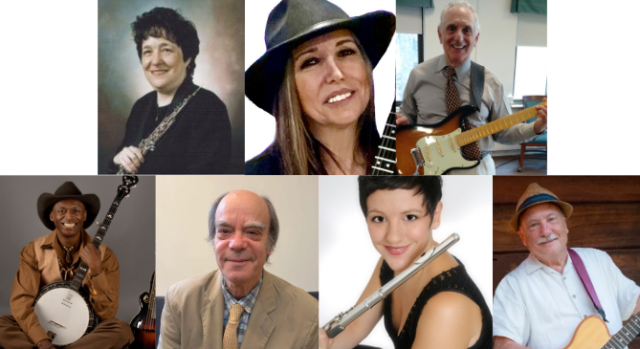
TOP ROW (from left): Ellen Bardekoff, Roberta Fabiano, Richard Frank; BOTTOM ROW (from left): Ayodele Maakheru, Jeff Nussbaum, Tereasa Payne Larry Siegel
THE MUSICIANS
Ellen Bardekoff is a Juilliard-trained oboist, educator, and ensemble director. She is best known as the founder of the Bardekova Ensemble, a chamber music group and non-profit organization that has brought accessible live classical, jazz, and popular music to senior centers and community venues across New York City – particularly in the Bronx – for decades. Alongside her performance career and collaborations with prominent orchestral musicians, she spent over 25 years teaching and directing award-winning student choruses in public schools.
Roberta Fabiano is a Berklee-trained guitarist, vocalist and composer who has worked as a featured performer with the Peter Duchin Orchestra. Throughout her decades-long career, she has performed at high-society galas, royal events at Windsor Castle, and multiple U.S. presidential inaugurations, while also collaborating with artists like Nellie McKay and legendary songwriter Doc Pomus.
Richard (Dick) Frank is professional guitarist and singer who has been a resource to the New York City music community since 1965, with a resume that hits all the high notes, including gigs with Neil Diamond, Bette Midler, Barry Manilow, Paul Anka, Patti LaBelle, Janis Ian, Peter Allen and Mary Travers (of Peter, Paul & Mary).
Ayodele Maakheru plays guitar, banjo, bass, mandolin, ukulele, harmonica, and bouzouki. He is also a vocalist, composer, performer and teacher who’s played with Billy Porter, Brian Stokes Mitchell, Audra McDonald, Leslie Uggams, Jeff Daniels, Ruben Santiago Hudson, Joaquina Kalukango, Woza Masekela Band and the New York Philharmonic.
Jeff Nussbaum is the director of Special Audiences and Musicians, a nonprofit that not only supports jazz musicians with disabilities but has an additional goal of performing for people who have limited ability to hear live music performances. Special Audiences regularly performs at senior centers such as the Visions Center and Lenox HIll Neighborhood House as well as many other such venues in the New York area.
Tereasa Payne is a multi-flutist, woodwind specialist and educator widely known for her extensive work in Broadway orchestras, including playing over a dozen world flutes for Disney’s The Lion King. A soloist with major orchestras like the Rochester Philharmonic, she performs her touring “Flutes of the World” educational concerts and has collaborated with artists ranging from Sir James Galway and Bernadette Peters to screen appearances on The Tonight Show and The Marvelous Mrs. Maisel.
Larry Siegel has performed for an entire lifetime (and then some) on guitar, banjo, mandolin, ukulele, harmonica, dulcimer, autoharp and as a singer, actor, composer, lyricist and producer. His credits include live performances on all seven continents worldwide (including Antarctica) and he has been a featured instrumentalist with Dolly Parton, Lester Lanin, Belinda Carlisle of the Go-Gos and John Phillips of the Mamas and Papas.
THE INTERVIEW
Allegro: Tell us what you enjoy about playing gigs at senior centers, retirement communities or nursing homes.
Ellen Bardekoff: It’s very rewarding. The audiences are very intelligent. They appreciate the concert; it’s fun for us and fun for them. It’s worth all the effort; we practice very hard.
Roberta Fabiano: I truly enjoy everything about playing these types of gigs. Most importantly, I enjoy knowing that I can make a difference to someone’s life by bringing them an hour or two of songs that they remember and love. I truly believe that music can be the best medicine for many people. For me, playing these types of venues is more a labor of “love” rather than “work.” I’ve seen first hand how playing the right kind of repertoire can bring joy and hope and camaraderie to a lot of these people who are alone and sometimes forgotten. In many situations, they are full time residents of nursing homes or assisted living facilities.
Richard Frank: I get paid to bring joy to older folks. I get to perform great classic music such as standards, classic rock and country, which is not what younger audiences yearn for.
Ayodele Maakheru: As a young musician, playing for seniors was an opportunity to learn a lot of vintage oldies in several genres. I’d research and practice music from four or five decades back. Now that I am a senior, the experience is more of a sing-along with old friends my age who’ve shared a similar music soundtrack history.
Jeff Nussbaum: It is simply a joy to have the Special Audiences ensemble perform at venues such as the Visions Center because it gives the musicians an opportunity to play for union scale, thanks to support from the Music Performance Trust Fund and it brings wonderful music to audience members who have a limited ability to hear live music performances.
Tereasa Payne: Playing for seniors is a unique experience that gives the musician the opportunity to open lines of communication with a community that often feels unseen and forgotten. The music is enjoyed on the level of listening and feeling it. But there is so much beyond that. Hearing the music unlocks emotions and memories that can then be expressed and shared between the musician and the recipient. This connection is what I love!
Larry Siegel: I’ve been performing for this demographic since I was in my 20s. They seemed so old then. Now they are basically my peers! It’s a whole different repertoire too. Back then, “senior” material was music from the 20s and 30s. Now it’s from the 50s and 60s. So I love playing for this population because we understand each other.
Allegro: What’s a typical gig like at these venues?
Ellen Bardekoff: We perform instrumental chamber music of various styles. Usually I like to put together a program with classical, baroque, romantic, and maybe some movie music, jazz or salsa. We ask questions with the audience, interact with each other. I give mini concert lectures. Sometimes the audience sings along.
Roberta Fabiano: First, I try to get to the venue an hour early. I’ve learned to bring a very small but powerful set-up that I can carry on a dolly. My set-up (and break-down) time only takes about 10 minutes. This gives me time to say hello to the people individually and ask if they have any requests. That’s one of the most important things to do if you want to be successful in this end of the music business. Also, it’s very important to do a lot of audience participation and to have good communication with the people. Sometimes the venue will have a particular theme and it’s wise to know that ahead of time and create a list of songs for yourself to perform.
Richard Frank: Mostly a concert situation with a modest PA system in a central location like a dining room. Also I stroll, either several units or room to room.
Ayodele Maakheru: I’ll often play a mixed menu of jazz, blues, international folk music, pop, rock and R&B classics. It’s typically guitar and voice but it’s nice to bring a banjo for some country, bluegrass and American folk tunes.
Jeff Nussbaum: The gigs are generally very informal with audience interaction.
Tereasa Payne: I play a variety of genres in the hopes of finding “something for everyone.” I talk in between each piece, sharing about the music, myself, my feelings…all in the hopes of making that connection in which the audience feels safe and comfortable to open up and share back. I welcome conversation with the audience and between audience members, often asking questions to spark debates and story sharing. One of my favorites is “Who was your favorite Beatles member?” The answers make everyone smile, laugh, remember and CONNECT!
Larry Siegel: For me it’s usually a concert type setting. I’ll do some interactive chatter between songs, asking them little “trivia” questions about the songs and the like. This helps to keep them engaged mentally, emotionally and musically. I also take requests and that also keeps them involved.
Allegro: What kind of music do you play? What kind of music seems to be the most well received by the audience?
Ellen Bardekoff: Remember, for these gigs, I’m offering instrumental music with a quintet, but even so, my audience likes a cross section of styles. It’s like a meal: they like their steak and mashed potatoes and salad! They like the masters: Beethoven, Mozart, Haydn. They like opera. They like jazz, salsa, the Great American Songbook. They just love to experience live music.
Roberta Fabiano: It really depends on where you’re playing, the type of place and where it’s located. For example, a nursing home might generally have older residents and in that case, I know I can do Cole Porter, Frank Sinatra, Patsy Cline, Willie and classic sing-a-longs like “Bye Bye Blackbird” or “Heart of My Heart” etc. Actually, the classic sing-a-longs work well in all of the venues I’ve performed. There’s a wide age range that always seems to know these songs. At assisted living facilities, I can play the American Songbook and also lots of classic rock and R&B through songs of today. I find Alzheimer’s patients and dementia groups to be the most diverse. They love and remember music from many different eras. I find senior centers generally like to pay tribute to the military, so it’s good to have songs for the Army, Navy, Marines and the Air Force.
Richard Frank: I cover a wide range. I adjust to the audience of the moment: standards. R&B, classic rock, country, “sing-a-long,” etc.
Ayodele Maakheru: Motown, classic rock and songs that reflect issues of social change in the 1960s are often crowd favorites.
Tereasa Payne: I play a combination of classical, Broadway, jazz, world music, opera and more. Audiences often come in with a preconceived notion of what to expect. I like to keep them guessing and learning about new styles of music! My “Tour of World Flutes” is absolutely the most loved of my programs! I share 10 to 25 world flutes (as many as I can fit in the time allowed!) and share stories about these instruments and the cultures that they are from.
Jeff Nussbaum: As a majority of our audiences are seniors, we play repertoire from the Great American Songbook, which is familiar to the audience. These performances also give the Special Audiences ensemble the opportunity to perform their original music, such as tunes from their recent release “From My Shiny Imagination: Tunes by Sam Baum.”
Larry Siegel: I never make a set list in advance. Instead I ask for requests since I know so many songs and I’m always surprised by what they call out! Since the population of those residences change from decade to decade, it’s no longer the venue for “Ain’t She Sweet” and “Yessir, That’s My Baby.” It’s now Elvis, Sinatra, Harry Belafonte, the Beatles, Neil Diamond, Motown, etc. and it will keep changing as time goes on. Each decade that goes by means that those populations change.
Allegro: How did you get involved in these kinds of gigs?
Ellen Bardekoff: In my career, I took every gig I could get and followed every connection I had. Eventually I made connections with senior centers. I met an author who had met and wrote about neurologist Oliver Sacks (author of “Awakenings”) and got even more connections into this world. Eventually I learned about the union’s MPTF funding and I started getting grants to do these gigs. If I find out about a new community center or venue, I’ll call them up and go after it. Seniors are great audiences. I’m motivated because music brightens their day up, it brings them tremendous joy!
Roberta Fabiano: I always had a calling for it. Before I went to Berklee, I was considering becoming a music therapist. I even did some volunteer work that was closely related to that field. Then my songwriting and love for performing got the better of me and I pursued other avenues of the music business. When my parents got older and their health started to decline, my mother ended up rehabbing in a nursing home and my dad was in an assisted living facility, that calling came back to me. The high society parties with the Duchin Band were getting fewer and fewer so I decided to get into these kinds of jobs wholeheartedly.
Richard Frank: Back in the early ’80s, I was breaking into club dates, but not enough weekday work. I met an agent who booked these kinds of hospital gigs. Then there was an organization called Hospital Audiences, Inc. (HAI) — later rebranded as the Healing Arts Initiative – and thus my journey began.
Ayodele Maakheru: The Music Performance Trust Fund had available performance dates in nursing, hospital, rehab and long term care facilities around the city. The Local 802 reps posted these opportunities around the office and asked members if they had any interest in playing for the residents, patients, families and staff.
Tereasa Payne: I work for “Concerts in Motion,” a NYC-based company that provides music for seniors and others who are experiencing isolation.
Jeff Nussbaum: It’s part of the mission of Special Audiences and Musicians to present performances at venues where audience members have limited ability to hear live music.
Larry Siegel: I started being sent to these places mostly through a nonprofit arts organization called HAI back in the early 80s. (they no longer exist) Now there are other nonprofits like Sing-For-Hope, etc. Also I have my own relationship with several residences. I also used to get sent to some of these locations from the Music Performance Trust Fund.
Allegro: What are the differences between playing a retirement community vs. a nursing home vs. a memory care (Alzheimer’s/dementia) facility?
Roberta Fabiano: No matter where I play, the question I always ask myself is, “What kind of music will be the most well received by the audience?”
Richard Frank: Repertoire and energy level.
Ayodele Maakheru: In either case, music serves as a key to accessing memories.
Jeff Nussbaum: Retirement community audiences tend to be a bit more interactive.
Tereasa Payne: I find the difference lies mainly in my expectations. I go in expecting silent appreciation. At the beginning of each concert, I find myself laughing at my own jokes, answering my own questions, etc. The different audiences will open up more as the concert goes on and they become comfortable. But sometimes, especially in memory care facilities, the reactions are subtle. But, they are there! Watch for the smiles in the eyes, the tapping of toes, the happy looks… These are all the connections that we make with our music!
Larry Siegel: Very big difference. Retirement communities are often dancing or participating in ways that look just like a “normal” gig. Cocktail parties, dinners, pool parties, etc. Assisted living and veterans’ homes are more like people in wheel chairs enjoying a concert-like show. When it comes to memory care, then you’re playing for the person’s “atmosphere” not their intellect. I mostly do those going from room to room and not in large groups. Though sometimes both.
Allegro: What have you learned by playing these kinds of gigs?
Ellen Bardekoff: I used to be shy. Then I taught choir for many years. I gradually lost my shyness and now I’m able to give lectures at my senior center gigs. Basically, over my lifetime of gigs, I’ve learned more courage.
Roberta Fabiano: I’ve learned to be more communicative with the audience for sure. I was so used to being a “side man” for many years, playing in many different kinds of bands. People come up to me now and tell me what a great entertainer I am!! I’ve never wanted to be an “entertainer.” That had nothing to do with being a great musician in my eyes. But now I’ve learned to take that as a huge compliment because from my experience in doing this, you have to be a communicator, you have to reach out to the people. Playing music in these kinds of venues can be the best medicine for these folks. Even if it just lasts for that one hour!
Richard Frank: I’ve continued to build my repertoire. Become a nicer person mostly. Developed an instinct for what different audiences will like. How to make sure I get paid.
Ayodele Maakheru: Music is a team sport and enhances any community gathering.
Jeff Nussbaum: Music is not only a source of enjoyment but one of healing.
Tereasa Payne: That everyone wants to be loved, seen and appreciated on BOTH sides of the performance!
Larry Siegel: How to respect people in every possible situation and to bring the highest quality to them no matter what their “capacity” is. Also, there are many ways that people show appreciation for what I’m doing and it’s not always obvious. Finally, I’ve learned to see the cues of when someone’s had enough.
Allegro: Any interesting stories from any of these gigs?
Ellen Bardekoff: Once, a piece of sheet music fell on the floor. I stooped down to pick it up. It wasn’t much of an effort, but I said “Physical therapy works.” These three words turned out to be a tremendous laugh line for this particular audience. I couldn’t have predicted it. When you’re natural, funny things happen. I create with my music, and also create with my words.
Roberta Fabiano: I was asked by a friend to bring my guitar and meet her and her family at a hospice facility where her sister Arlene was dying. I had asked the family what Arlene’s favorite songs were and started playing and singing them for her. Her eyes eventually opened up and she ended up leaving the facility alive! It was an unforgettable moment. The medicine of music gave Arlene six more months of life!
Richard Frank: Zillions! One of my favorites: A chap at an assisted living joint was wearing two different socks. I commented on it and he said “Oh, you like ’em? I’ve got another pair just like ’em in my room!”
Ayodele Maakheru: I was visiting my father in law at a rehab home and I heard music playing down the hall. When I walked to the cafeteria, I saw a fellow Local 802 member entertaining the patients.
Jeff Nussbaum: One funny story was at a gig at a nursing home where an audience member asked when the band will return to play again and the leader said, “Oh, probably in six months.” Where the very senior audience member replied, “Six months!? Half of us will be dead by then!”
Tereasa Payne: My favorite story was in playing my “Tour of World” flutes for a memory care facility. One gentleman was opening up discussing fairly intricate music theory with me. I allowed him that space to talk and discuss. Afterwards the staff told me that is usually non-verbal, but he had been a concert pianist. The music opened up a world that he knew and embraced!
Larry Siegel: So many! Occasionally I’ll interact with someone and I’ll find out that they are someone from our business. A musician from their own time in the past. Sometimes 802 members. Sometimes even well-known. Just the other day I played a residence on the Upper West Side and a woman was kind of yelling her demands to me from the audience. I made light of it and it turned out that it was Caroll Baker, a famous movie star from the 50s!
Allegro: Is there anything about your musical background that has especially helped you with these kinds of gigs?
Ellen Bardekoff: My entire musical career allows me to do these gigs, including my Juilliard training. Music leads you to everything.
Roberta Fabiano: Doing club dates has definitely helped. Playing with the Peter Duchin Orchestra has especially broadened my repertoire over the years in a big way. Our focus has always been to play “dance music” – whatever we have to do to get people up and dance and to keep them up on the dance floor. The amount of tunes (which is very diverse) that the Duchin band knows is endless.
Richard Frank: All of it: studios, Broadway, playing for many entertainers of wide acclaim and, of course, club dates with the best sub leaders in the biz.
Ayodele Maakheru: The combination of professional music experiences which will range from clubdates, Broadway shows, bar/restaurant gigs and teaching all contribute to the playlist.
Jeff Nussbaum: Knowing older repertoire!
Tereasa Payne: Knowing a lot of genres helps to have music for everyone!
Larry Siegel: I’m a singer/guitarist and an entertainer so it’s a very comfortable shift I make to have a rapport with the attendees. I’m also kind of a “human jukebox.” I know thousands of songs in my head (no iPad needed) so when I ask for requests and they call out an artist or song title, I usually just jump right in on it before the sentence is even finished. Much better than having to scroll through a book or tablet.
Allegro: What instrument(s) do you play for these kinds of gigs?
Ellen Bardekoff: My quintet is flute, oboe, clarinet, bassoon and French horn.
Roberta Fabiano: I play guitar and I sing. Sometimes, if there is a piano in the room and it’s in tune, I’ll switch to the piano especially if I’m playing another section of the building immediately afterwards and have no time to spare. It saves time in packing up and getting to the next performance so both rooms get the full hour of music that they’re entitled to.
Richard Frank: Electric or acoustic guitar and voice.
Ayodele Maakheru: Guitar, banjos, ukulele and bouzoukis.
Jeff Nussbaum: The Special Audiences ensemble consists of piano, bass, drums, congas, guitar/harmonica, baritone sax, tenor sax and violin.
Tereasa Payne: Flute and world flutes
Larry Siegel: Mostly voice and guitar. On various themed events it might be banjo or uke. I also add harmonica sometimes. (Dylan is often requested)
Allegro: If other musicians want to do these kinds of gigs, what advice would you give?
Ellen Bardekoff: Go for it! If you really want to do it and help these people by letting them enjoy your music, practice hard. You must practice at the highest level. These audiences must know that you are playing the best you can. You can’t play down to them.
Roberta Fabiano: If you’re interested in doing this type of gig, you have to put your heart into it. It’s not to be thought of as a place where you can just get up there and play a few tunes that you know and make a quick buck for one hour’s work without caring or thinking of what songs these people would like. You may think these people aren’t listening because they might not be able to show emotions or they might not be physically able to even clap their hands but they are listening to you! You’ve got to play for them, not for yourselves…that’s when the medicine of music will truly work.
Richard Frank: The only advice I ever give is “Don’t take my advice!”
Ayodele Maakheru: If you’re having fun, so will they.
Jeff Nussbaum: Just ask!
Tereasa Payne: Start compiling setlists, contacting senior centers, and go in with a smile, an open heart, and lots of stories to tell!
Larry Siegel: Decide on your target audience and learn from them. Also, give your gift of music as a service to them. It always works out better when you’re serving with music rather than expecting them to adjust to you.
Allegro: Is there anything else you’d like to say about playing these kinds of gigs?
Ellen Bardekoff: It’s an absolute gift to be able to do these concerts. And the MPTF allows me to do that. Seniors are the gold of our generation. These are the people that need to be respected more; they have life experience that other audiences don’t have. They are the gold of our society. They deserve to be entertained and enjoy music for whatever time they have left.
Roberta Fabiano: My dream would be that all facilities would someday come to realize the true need for having live music every day for their residents. There are so many great musicians out there who would be available to provide the music that is needed. It is a very rewarding experience.
Richard Frank: Most of these gigs are in the daytime, so I can have dinner with my wife. Among the things I didn’t like about Broadway was rarely spending time with her in the evening.
Jeff Nussbaum: You don’t need to be playing at Carnegie Hall to be an important gig.
Tereasa Payne: It is the most fulfilling part of my career!
Larry Siegel: You must love it, or at least like it. It’s too obvious when you don’t.
EDITOR’S NOTE: A few of the members above spoke about getting “MPTF grants” to play this kind of work. Some of these gigs are also organized by the Council For Living Music. If you play senior gigs and would like your story considered for a future issue of Allegro, send an e-mail to allegro@local802afm.org.