
Allegro
The Sustainable Bow
Volume 126, No. 2February, 2026
This article originally appeared in the January 2026 issue of Symphony, the publication of the League of American Orchestras, and is reprinted by permission. Visit symphony.org/ to learn more.
From November 24 to December 5, 2025, the global Parties to the Convention on International Trade in Endangered Species of Wild Fauna and Flora (CITES) treaty met in Samarkand, Uzbekistan. A proposal under consideration, from Brazil, was the relisting of pernambuco (pau-brasilia echinate) on Appendix I, the highest level of protection. At the conclusion of the conference, the Parties voted to keep pernambuco on Appendix II, with new permit requirements for international sales. The permit system will go into effect on March 5, 2026. In addition, there will be new global partnership efforts to strengthen compliance, establish traceability systems for the wood, and support a sustainable future for the species. International travel for purposes that do not involve transferring ownership of a bow — such as paid performances and repairs — will not require permits.
The stakes were high for musicians around the world. Most high-quality bows are made of pernambuco, and an Appendix I listing would have had devastating consequences for traveling orchestras and string players without corresponding gains for the conservation of the species, which grows only in Brazil.
The outcome was not guaranteed. Heather Noonan, Vice President for Advocacy for the League of American Orchestras, who played a leading role in organizing global music stakeholders in advance of the CoP and represented the voice of music makers during the negotiations in Samarkand, says, “Brazil came to the table with absolute commitment to the Appendix I listing, while also signaling concerns for traveling musicians.” Brazil also requested that the working group that was convened to discuss the matter be limited to the governmental representatives, which is unusual. However, Noonan says, “In collaboration with other stakeholders, we were able to engage with the parties and seek a balanced approach. The negotiating parties needed essential information from music stakeholders to make informed decisions, like the volume of bows that cross borders and assurances of support for conserving wild-grown trees.” She adds, “The U.S. government, alongside other global parties, was very involved in the working group, and highly effective at bringing forward facts about international travel with musical instruments and bow production. Their leadership and partnership was essential on the ground.”
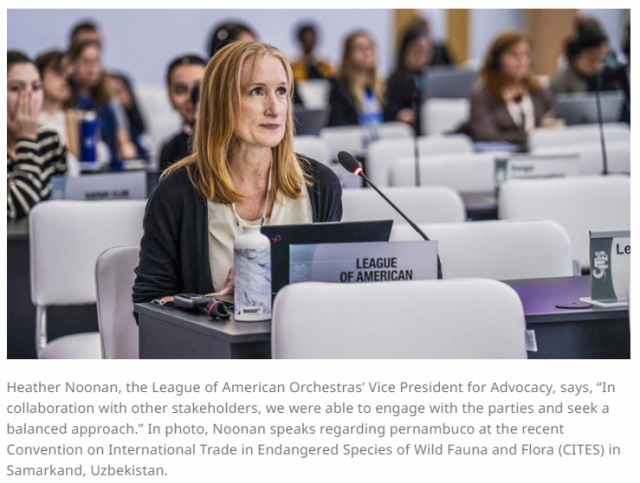
A U.S. Fish & Wildlife representative concurred, stating in an email: “The goal of the United States in the in-session working group was to explore options for supporting Brazil’s efforts to combat illegal logging and associated trade in pau-brasilia, while also protecting the ability of musicians to travel internationally to perform with bows (and other instruments) made from the species. The music industry stakeholders worked diligently with international partners in the lead-up to CoP20, and at the meeting, to ensure that their perspectives were considered in the decision making.”
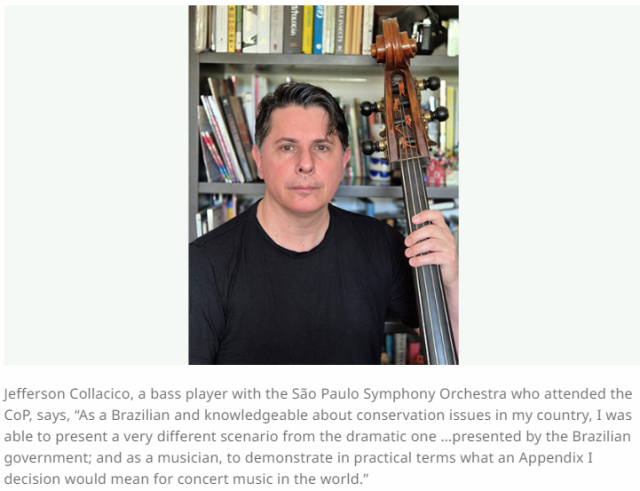
Jefferson Collacico, a bass player with the São Paulo Symphony Orchestra who attended the CoP, noted the tension around the issue. “Since the COP deals with very varied subjects, many details can be missed and the discussions are, let’s say, emotional. The Parties that were aware of the barriers to travel for musicians immediately opposed the Appendix I listing. Countries without full knowledge of the implications for orchestras, however, supported it. Perhaps it is one of very few conservation problems in the world concerning a renewable resource directly affecting an entire class that has never participated in the trafficking or smuggling of the material.” Collacico was able to advocate successfully. “As a Brazilian and knowledgeable about conservation issues in my country, I was able to present a very different scenario from the dramatic one — that there are only 10,000 pernambuco trees in Brazil — presented by the Brazilian government; and as a musician, to demonstrate in practical terms what an Appendix I decision would mean for concert music in the world.”
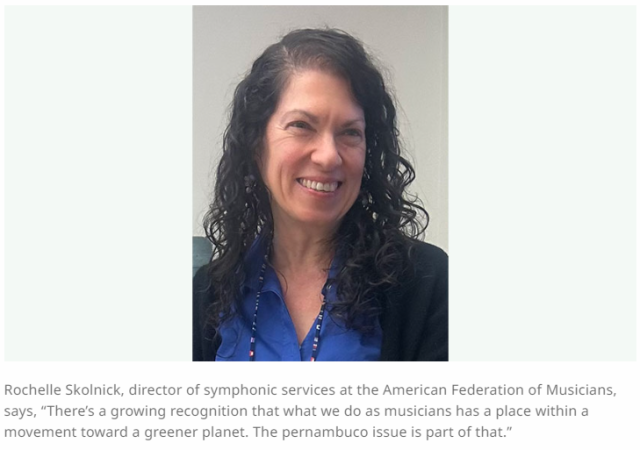
Rochelle Skolnick, director of symphonic services at the American Federation of Musicians, says, “Our overarching sentiment is relief. A placement on Appendix I would have seriously limited musicians’ ability to travel and it would have severely undermined musicians’ ability to rely on the value of their investments in bows. Musicians spend a lot of money on their equipment, and a big part of that for a string player is bows. To a certain extent, the investments we make in instruments and bows are a retirement strategy; we do not have a lot of other resources. It would have been devasting on so many levels.”
Benoit Machuel, general secretary for the International Federation of Musicians (FIM), adds, “Listing pernambuco on Appendix 1 would have created an enormous burden for the CITES authorities tasked with issuing the permits and it would most probably have meant the end of the bowmaking community.” France is the birthplace of traditional bowmaking and an important center for the craft, and advocates from the Chambre syndicale de la facture instrumentale (CSFI), Confederation of European Music Industries, and Pearle Live Performance Europe were deeply engaged in advocacy. Emmanuel Macron, the president of France, intervened directly with Brazil late in the process to advocate for the more flexible solution.
The next steps will involve action by global CITES authorities to implement the new permit regulations for international sales of bows. Makers and owners planning to sell across borders will need proof that the wood in their bows was harvested prior to September 13, 2007, when the species was first put under international protection. The League of American Orchestras, in partnership with the AFM, FIM, and the International Alliance of Violin and Bow Makers for Endangered Species and others, has been presenting a “Know Your Bow” campaign, providing educational tools to get the word out about the need for documentation for several years, and there is a new urgency for musicians, retailers, and makers to take action. Now, documentation is essential, and not just for sales. Machuel says, “Although the movement of bows with no change of ownership does not need a permit, for the sake of clarity and safety, I would recommend that every bow owner gathers documentation and certificates so they know where it comes from, when it was manufactured, and the origin of the wood, so there is no mistake about dates (pre- and post-2007).”
The new guidelines and permitting process are currently under development in the U.S. and across the 184 other Parties to CITES. The U.S. Fish & Wildlife Service (USFWS) states that it “is currently working with industry stakeholders to identify the best avenue for communicating with individuals and businesses that will be impacted by the new requirements. While we are developing implementation plans now, we expect to undertake coordination and consultation in earnest early in the new year.” The Service will also work with the League of American Orchestras and other stakeholders to develop technical assistance tools as implementation of the new rules begins. Representatives will attend the NAMM (National Association of Music Merchants) Show in Anaheim, CA, in January 2026, participating in a panel alongside the League’s Heather Noonan on CITES and musical instruments and staffing a booth to answer questions regarding permitting requirements and procedures as well as general questions regarding CITES and the movement of musical instruments. A nationwide webinar hosted by the League in partnership with USFWS and national music partners will take place on February 10, and updated to the Know Your Bow guidance are underway.
And that’s not all. “Everyone needs to understand that this decision is valid for the next three years,” Machuel says. “There is no guarantee that Brazil will not come back at the next CoP in three years with another proposal to list the wood on Appendix I. We can make the international commercial movement of bows traceable; we can manage traceability of pernambuco stocks, resales, etc. It’s very important that the entire music community does its part, so at the next CoP, everyone can see and understand that the solution taken at CoP 20 is viable and sustainable.”
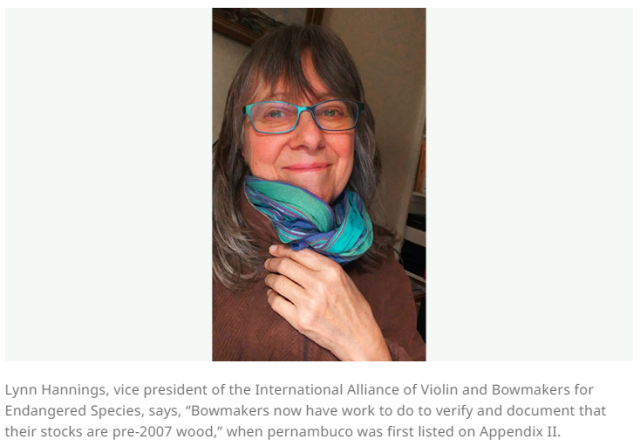
The work on traceability of bowmakers’ pernambuco stocks has already begun. Several countries, including Germany and France, have established national registries; the U.K. instituted one just before the CoP began. In the U.S., the approach has been voluntary. Bowmaker Lynn Hannings, vice president of the Alliance, says, “In 2007, when pernambuco was first listed on Appendix II, we were given some general information by U.S. Fish & Wildlife. Makers were advised to do an inventory of their legal stocks: how many boards, how many sticks, their weight; take pictures, date stamp the document, have it notarized, and put it in safe place. Because it was considered voluntary, some people never got around to it, but many did. For those that didn’t, they now have work to do to verify and document that their stocks are pre-2007 wood.”
The bigger picture involves collaboration with Brazil and IBAMA (Brazilian Institute of Environment and Renewable Natural Resources) for the future sustainability of the species. One disturbing aspect of the Appendix I proposal was the drastic undercounting of the number of plantation trees already growing in Brazil; these actually include the 340,800 seedlings planted by the International Pernambuco Conservation Initiative (IPCI) over the last 25 years, and others. As part of the CoP20 decision, information was requested about non-wild specimens, including the number, size, and their viability to provide wood of sufficient quality to supply demand for production of bows. In theory, this would have Brazil providing information about plantation-grown pernambuco, a future sustainable resource for bow making.
Some progress is already being made. IPCI has just entered an agreement with a university in Bahia to create the first seed bank for Brazil. Another group, the Brazilian Coalition on Climate, Forests and Agriculture, which encompasses more than 400 representatives from the private and public sectors, is getting funding from the Brazilian government to work on regrowing and restoring native species, including pernambuco, in mixed-use plantations.
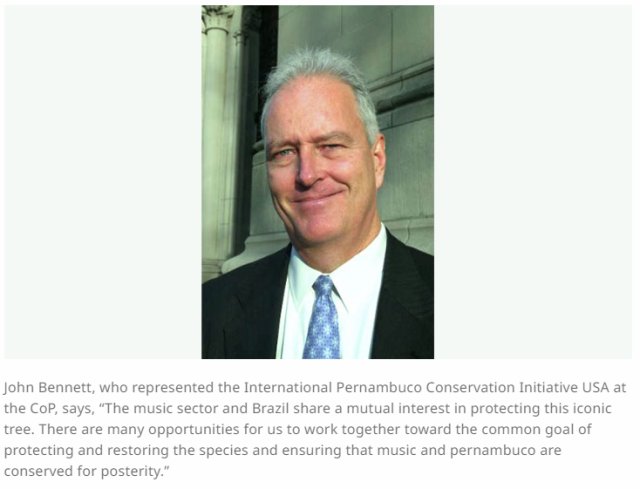
John Bennett, who represented IPCI USA at the CoP, says, “The music sector and Brazil share a mutual interest in protecting this iconic tree. I think there are many opportunities for us to work together toward the common goal of protecting and restoring the species and ensuring that music and pernambuco are conserved for posterity.”
Rochelle Skolnick also believes that musicians have a role to play. “At FIM’s international conference in Sweden in October 2024, a topic of conversation was about what we and our institutions can do to better protect the planet. There’s a growing recognition that what we do as musicians has a place within a movement toward a greener planet. We have to be cognizant of the impact of everything we do on the physical and climate health of the planet. The pernambuco issue is part of that.”
Heather Noonan agrees. “Musicians and music itself can be an influential ambassador for the future of this iconic species, and coordinated action across our sector and global governments, in partnership with Brazil, can protect trees and musical instruments for future generations.”
Visit the League of American Orchestras’ Pernambuco Policies and Conservation site to stay up to date with the latest developments, resources, links, and regulations. In Know Your Bow, the League provides detailed, regularly updated information about pernambuco, the wood that is used in most advanced student and professional instrument bows.