
Allegro
PRO-LABOR THEATER STILL INSPIRES US TODAY
A revival of "Waiting for Lefty" includes classic and new labor songs
Volume 126, No. 10November, 2026
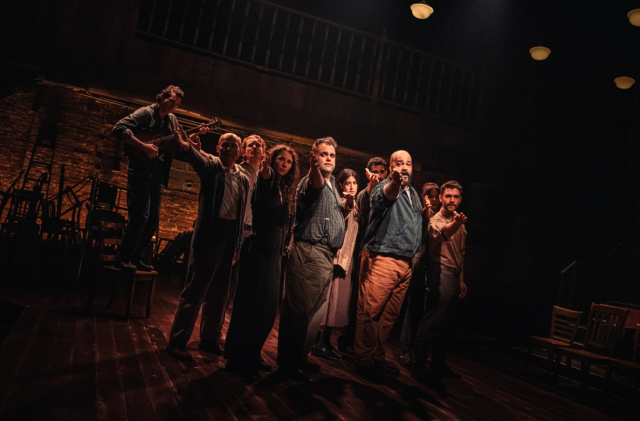
A revival of “Waiting for Lefty” includes classic and new labor songs
Clifford Odets’ first produced play, “Waiting For Lefty,” opened at the Civic Repertory Theater on 14th Street in New York in 1935. A play about a cabby strike, it tapped into the rapidly rising support for union rights in the depths of the Depression. Two months later, it opened on Broadway and ran for 160 performances. The script was instantly in demand in theaters across the country and Odets became an icon of American theater.
Now the play has been revived at the Classic Stage Company, a few blocks from where it originally opened. The director Steve Pasquale has chosen to add songs and choreography to transport the audience back to a time that was similar to our era of wealth inequality and the fight for labor rights. The music and movement sometimes gives the play a dreamlike atmosphere as if to suggest to the audience that perhaps what is happening in America is an awakening to a not-so-new reality.
One of the strengths of the new production is the addition of songs, many of which have derived from the labor movement and will be familiar to union activists in the audience, especially those of older generations. The opening song is “Bella Ciao,” a piece from an Italian textile strike of the 19th century and later used as an anti-fascist anthem among Italian partisans as Mussolini rose to power. It’s sung beautifully by the actor and singer Sahar Milani and then the tune is hummed by the ensemble as the scenes begin.
Other songs include Florence Reece’s “Which Side Are You On” from a Harlan County miner’s strike in the 1930’s, Yip Harberg and Jay Gorney’s “Brother Can You Spare A Dime,” composed during the Great Depression (and which prompted calls for radio stations to ban the song because it was perceived as too critical of capitalism) and “Bread and Roses,” the James Openheim poem turned song that paid tribute to the women strikers in Lawrence, Massachusetts in 1912 and their slogan, “We Want Bread – But We Want Roses Too!” The oldest piece in the play is the “Digger’s Song,” written during a 17th century uprising in England for land rights. The actors sing the songs, while two of the actors also play guitar, banjo and violin. The songs blend imaginatively with movement by the actors choreographed artfully between scenes. (The show is covered by a union contract.)
Unlike the 1935 production, the play now is dated, the script retaining the language and references to that era. But the message rang familiar to the audience the night I attended the play and echoed the same frustration of trying to make a living in New York City, while oligarchs wield political and economic power. Unity and solidarity are the clear themes of the play.
Labor popularity is enjoying a surge in recent years with struggles in the news like the UAW strike and the organizing of Amazon and Starbucks workers, though union density is still on a steady decline, demonstrating the necessity of labor law reform. But 1935 was also an era of change and the demand for laws protecting workers was part of the movement. Waiting for Lefty encapsulates these issues with an emotional impact. And without a doubt the addition of music and songs strengthen that impact.
The play runs through November 22 at the Classic Stage Company on East 13th Street.
John O’Connor is a songwriter, guitarist and poet. He has been a member of the AFM since 1980, a member of Local 802 since 1996 (where he also served as recording vice president for many years) and a founding member of Local 1000, chartered in 1993. John’s original song “Carpal Tunnel Syndrome” also appears in “Waiting for Lefty.”